Wild camping in Italy may be permitted, restricted or prohibited depending on the region, municipality and type of land. Italy has no single national rule that authorises or bans free camping everywhere. Regional legislation usually sets the general framework, while municipalities, park authorities and other public bodies may introduce additional restrictions through local ordinances.
Although the rules vary across Italy, most regions either prohibit or heavily restrict wild camping outside authorised campsites, designated rest areas or specifically approved locations. This means that you should never assume that an attractive beach, forest clearing, mountain lay-by or quiet country road is available for an overnight camp simply because no barrier is present.
The legal position can change within a short distance. One municipality may allow overnight parking in a particular area, while a neighbouring municipality may impose time limits, overnight parking restrictions or other local conditions. Temporary ordinances may also apply during festivals, periods of heavy traffic, wildfire risk, public events or civil protection emergencies.
Penalties for unauthorised camping are determined by regional legislation and municipal ordinances. Administrative fines vary widely across Italy and may range from modest fines to several hundred euros, depending on the applicable local legislation. Because the legal basis and penalty differ from place to place, you should treat this range as a planning indication rather than a fixed national tariff.
For a broader overview of route planning, road rules and overnight options, continue with Italy by Motorhome & Caravan.
What is the difference between parking and camping?
A parked motorhome remains a vehicle; a motorhome used in a way that expands beyond its normal road footprint may be treated as camping. Article 185, paragraph 2, of the Italian Codice della Strada states that parking an autocaravan does not constitute camping when the vehicle rests only on its wheels, releases no discharge other than that produced by the engine and occupies no more space than its own dimensions.
You can consult the current legislation through the official Normattiva version of the Italian Highway Code.
In practical terms, you generally remain within the concept of parking when:
- your motorhome stands only on its tyres;
- you keep the awning, steps, tables, chairs and external kitchen equipment inside;
- you do not open windows or other elements beyond the vehicle’s ordinary footprint where this increases the occupied space;
- you do not release grey water, black water or other liquids onto the ground;
- you follow the signs, marked bays, time limits and payment conditions that apply to every other vehicle.
By contrast, using the area around your vehicle—for example by placing chairs outside, extending an awning or setting up cooking equipment—may cause your stop to be regarded as camping rather than parking under applicable regional laws or municipal ordinances. Even where overnight parking is permitted, these actions may breach local rules or move your stay from lawful parking into unauthorised camping.
A useful legal figure concerns paid public parking. Article 185, paragraph 3, allows parking tariffs for motorhomes to be set at up to 50% more than the tariff charged to cars in the same area. This does not give motorhomes a right to occupy unsuitable bays, but it confirms that the Highway Code recognises them as vehicles entitled to use ordinary parking under the applicable conditions.
Would you prefer to see organised rural stopovers before planning your route? Open the free Agricamper Demo to preview the app, map and main planning features before joining.
Where are the rules stricter?
Protected areas, national parks, many coastal destinations and sensitive mountain areas often apply stricter controls than ordinary urban parking areas. In these locations, environmental protection rules, park regulations and municipal ordinances may apply in addition to regional camping legislation and the Italian Highway Code. A place that appears physically accessible may still be subject to park regulations, landscape restrictions or a municipal ordinance.
In some Italian national parks and protected areas, penalties for unauthorised camping or related environmental offences may reach around €3,000 under the applicable regulations, depending on the conduct involved. You should always check the website and signage of the individual park authority before entering remote roads or planning an overnight stop.
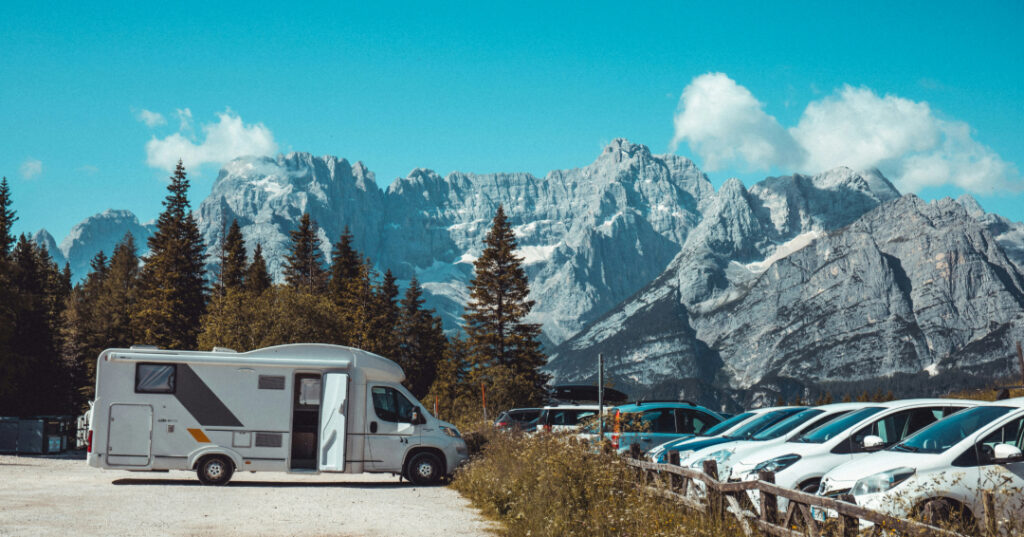
Enforcement is particularly strict in South Tyrol and in many popular areas of the Dolomites, where municipalities and protected-area authorities actively regulate overnight parking, roadside occupation and access by recreational vehicles. This does not make the region inaccessible by motorhome. It simply makes careful planning, authorised stopovers and respect for local signs especially important.
Every season still offers a practical solution. In spring and autumn, you can combine rural stops with quieter cultural routes; in summer, organised valley and countryside stopovers provide alternatives to sensitive mountain areas; in winter, authorised locations help you plan safely around road and snow conditions. These are planning strategies rather than legal exemptions.
Before stopping, check:
- the road signs at the entrance to the municipality and parking area;
- any height, width, weight or time restrictions;
- whether the land belongs to a national park, regional park or nature reserve;
- whether overnight parking is expressly restricted;
- whether the parking bay can contain your entire vehicle without obstruction.
What happens if you discharge waste water?
Discharging grey or black water onto public land is prohibited and is separate from the question of whether your vehicle is parked or camping. Article 185, paragraph 6, of the Italian Highway Code provides for an administrative fine of €87 to €344 for unlawfully discharging grey water, black water or organic waste onto roads or public areas outside authorised disposal facilities.
Environmental legislation may create further obligations. Article 192 of the Italian Environmental Code prohibits the uncontrolled abandonment or deposit of waste on or in the ground. Depending on the circumstances, the competent authority may require the responsible party to remove the waste and restore the site. You can consult the official text through Normattiva’s Environmental Code
Serious environmental offences may result in criminal proceedings in addition to administrative penalties, depending on the circumstances and the applicable legislation. These consequences are not automatic for every spill, but they show why responsible water management is essential.
Keep both tanks closed while parked and use only authorised motorhome service points. For practical guidance, read Motorhome dump stations in Italy, including how to locate suitable facilities along a multi-stage route.
Related support pages:
- Driving in Italy with a motorhome or caravan: what should I know?
- What types of vehicles are accepted by Agricamper?
Can a municipality ban motorhomes from parking?
A municipality may regulate motorhome access and parking, but a blanket restriction must have a lawful and properly justified basis. Under Article 185, paragraph 1, motorhomes are generally subject to the same road-traffic rules as other vehicles. This does not prevent targeted restrictions based on legitimate considerations such as road safety, vehicle dimensions or weight, traffic management, or environmental protection.
In judgment no. 1771/2022, the Regional Administrative Court of Puglia annulled an emergency municipal ordinance restricting motorhome entry, transit and parking because the municipality had not demonstrated the serious and imminent danger required to justify the use of emergency powers. The decision is available through this published summary of TAR Puglia judgment 1771/2022.
This case does not mean that every motorhome restriction is invalid. Municipalities may still impose specific traffic or parking restrictions where these are authorised by law and justified by legitimate considerations such as road safety, traffic management, vehicle dimensions, infrastructure constraints or environmental protection. The practical lesson is simple: a sign cannot be ignored merely because motorhomes normally share the same parking rights as other vehicles.
When you encounter a restriction, follow it and choose another authorised location. If you believe an ordinance is disproportionate, challenge it through the appropriate administrative procedure rather than arguing at the roadside.
An alternative to wild camping in Italy
A farm stop offers a peaceful alternative to the uncertainties of camping by the roadside.
You stay on private land with the host’s permission, respect the agreed conditions and, with Agricamper, continue your journey at the end of the authorised 24-hour stay. Agricamper stops are reserved for self-contained motorhomes, campervans, rooftop tents and caravans.
Agricamper, Italy’s farm-stop network, offers unlimited free 24-hour stops at farms and wineries across Italy.
This model works particularly well for a road trip, as you can combine rural stops with campsites, official motorhome areas and regular parking spaces where overnight parking is permitted. There is no need to plan your entire itinerary around a single type of overnight stay. Instead, you can choose what works best for each stage of your journey, the season and your destination.
A farm stop also removes much of the legal uncertainty discussed in this guide. You stay on private property with the host’s permission, and the conditions of your stay are agreed in advance.
Plan your road trip through Italy: discover the Agricamper membership and its network of rural 24-hour stopovers.
Frequently asked questions about wild camping in Italy
Can you sleep overnight in a motorhome parked on the street in Italy?
You may sleep inside a lawfully parked motorhome when the stop remains legally classified as parking rather than camping. The vehicle must stay on its wheels, release no waste and occupy no more than its normal footprint. Local signs, parking limits and municipal ordinances still apply, so overnight parking is not automatically permitted everywhere.
Is wild camping banned throughout Italy?
No. Italy does not have a single nationwide law that bans wild camping in every location. Instead, the rules are primarily set by regional legislation, municipal ordinances and the regulations governing national parks and other protected areas. Because most regions restrict or prohibit unauthorised camping, you should verify the rules for the exact municipality and site before stopping.
Can I put chairs or an awning outside my motorhome?
Putting chairs, a table, an awning or other equipment outside may cause your stop to be treated as camping rather than parking. Under Article 185 of the Italian Highway Code, a motorhome remains legally parked only if it rests on its wheels, releases no waste other than engine emissions and occupies no more space than its own dimensions. Use external equipment only at a campsite, authorised area or private stopover where the host permits it.
Can I stay overnight in a national park in Italy?
You may stay only where the national park’s regulations and local signs expressly permit the type of stop you intend to make, whether that is parking or camping. Protected areas often impose stricter rules than neighbouring municipalities, and penalties for breaches may be significant. Check the individual park authority’s official information before entering remote access roads or planning an overnight stop.
Can a motorhome use the same parking spaces as a car?
A motorhome generally has the same parking rights as other vehicles, provided that it complies with the applicable traffic rules and any lawful parking restrictions. Municipalities may still introduce justified restrictions based on road safety, traffic management, vehicle dimensions, infrastructure constraints or other legitimate public interests. In public paid parking areas, motorhome parking fees may be up to 50% higher than the corresponding car tariff.
Where can I legally empty grey and black water in Italy?
You must empty grey and black water only at authorised motorhome service points, campsites or designated disposal facilities. Releasing waste water onto roads, parking areas or public land may result in administrative penalties under the Highway Code and, where the Environmental Code applies, an order to remove the waste and restore the site. Plan disposal points in advance, particularly before entering mountain, coastal or protected areas.