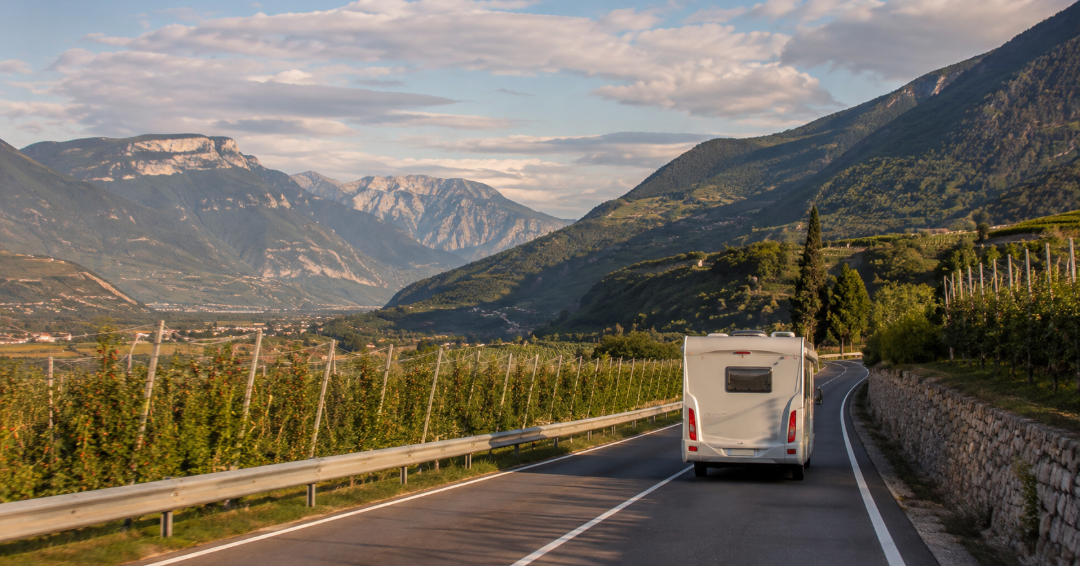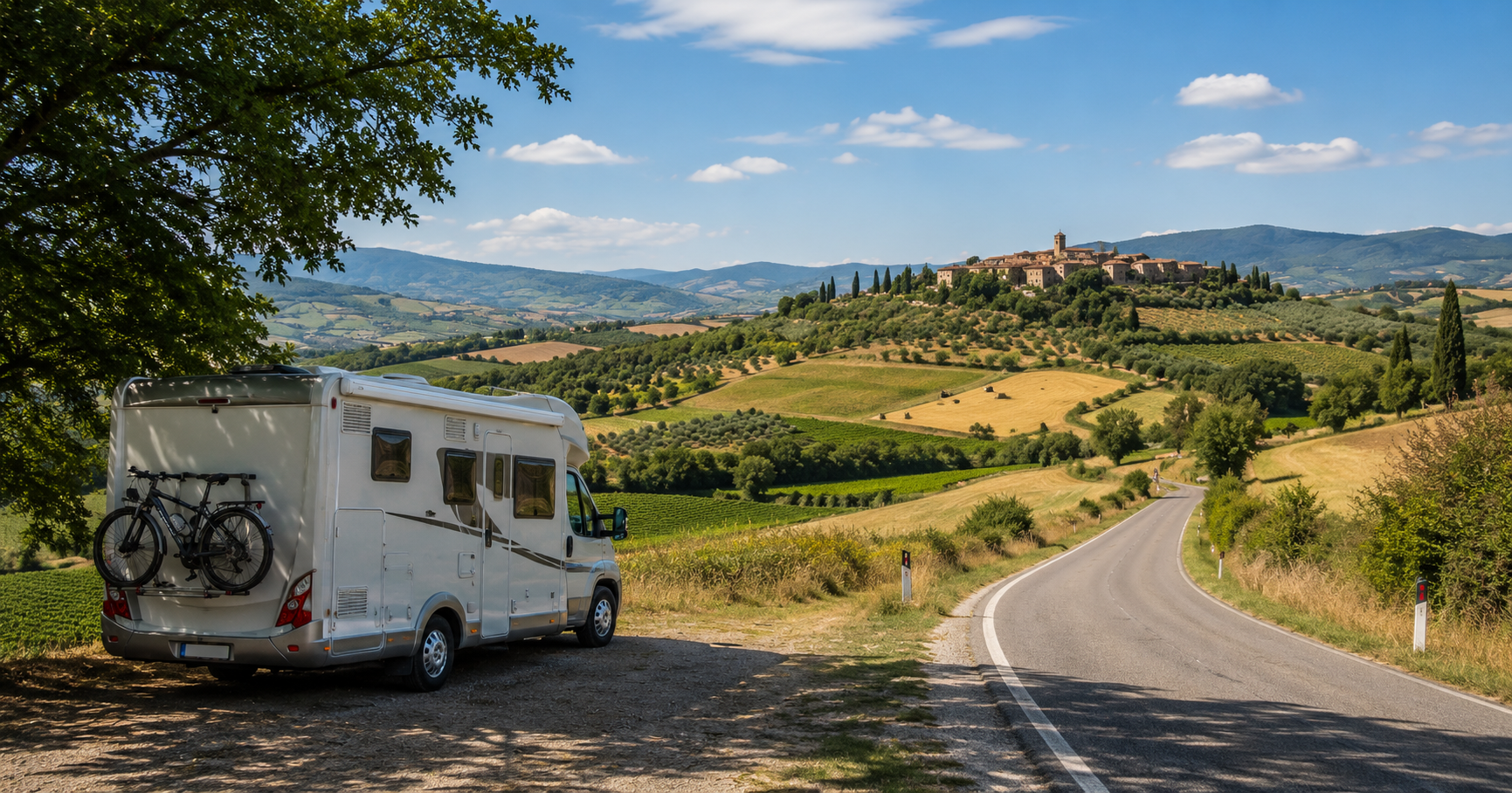
Planning a trip to Italy by motorhome, campervan or caravan? Here is what you need to know before you go: free camping is prohibited everywhere in Italy, a campsite night costs on average €63 in high season, and yet hundreds of farms and wineries across the country welcome you for free through Agricamper. In this guide you’ll find the camping rules explained simply, the real costs and how to avoid them, the documents and equipment the law requires, the driving rules that surprise foreign visitors most, and route ideas covering the whole country — from the Dolomites to Sardinia.
Camping rules in Italy: what is actually legal
Free camping is prohibited in all Italian regions, but parking a motorhome is legal wherever parking is allowed. The difference is precise: your vehicle rests only on its wheels, releases no waste, and occupies no more space than its own footprint. The moment you open a horizontal window, roll out the awning, or set up a table and chairs, you are “camping” — and you risk a fine. Enforcement varies from place to place — parking falls under the national highway code, but camping is governed by regional laws and municipal ordinances. Sardinia and South Tyrol (Alto Adige) are the strictest, along with coastal areas in general: fines typically run between €25 and €500 under local ordinances, and up to €3,000 in national parks and protected areas.
For caravans the rule is stricter: leaving a caravan parked alone on public land is forbidden. You may park car and caravan together, where signposted, within marked spaces.
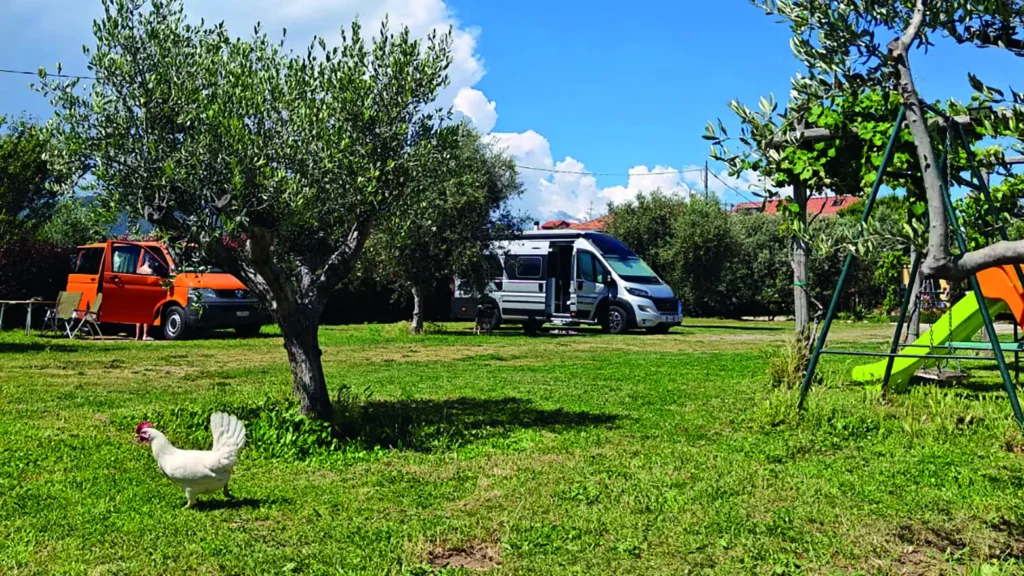
So where do you sleep outside campsites? Three options: sosta areas (dedicated motorhome parkings), agricampeggi (paid farm campsites), and Agricamper, Italy’s farm-stop network, where you are welcomed on the private land of farms and wineries — with the host waiting for you.
How much camping in Italy really costs — and how to sleep free
Italy is the second most expensive country in Europe for camping, after Croatia. In high season 2026, a family of two adults and one child pays on average €63 per night at an Italian campsite — against €46 in France, €43 in the Netherlands, €41 in Germany and a European average of €49. A five-star pitch in Italy averages €91 per night, and across Europe a seaside pitch costs on average 36% more than a comparable one inland. Travelling off-season saves Italian campers about €24 per night, roughly 38% (source: ADAC – PiNCAMP Price Analysis 2026). Still, over a two-week summer trip in high season, that is close to €900 in campsite fees alone.
Between campsites and free stops sit the paid sosta camper areas: count on €15–25 per night depending on region and services, rising to €30–35 in tourist hotspots like Alto Adige — often for a parking space with hookup and basic facilities. Even this “budget” option costs, per night, around half of what a whole year of farm stops costs.
The alternative: Agricamper gives you unlimited free 24-hour stops at farms, wineries and rural hosts across Italy for a €39.90 annual membership. You park on private land, meet the producers, taste their wine and olive oil, and bring home what you loved — no pitch fee, no booking months ahead. By the way: caravans and self-contained roof tents (with their own toilet on board) are welcome at most hosts too — filterable in the app. One night at a standard campsite costs more than the entire year of membership, so the maths take care of themselves. Curious how it works in practice? Read how Agricamper Italia works.
👉 Download the Agricamper app and open the free Demo version: you’ll see the map of all the hosts and can browse them before deciding anything.
400 free dump stations, open to everyone
Emptying grey or black water in nature is first of all an environmental harm — detergents and waste end up in the soil and streams of the very places we travel to enjoy. It is also heavily fined in Italy, and in serious cases the authorities can even seize the vehicle. The Agricamper app shows 400 free dump stations directly on the map, marked with blue pins, and this feature is free for everyone, members or not: open the Demo, filter “Dump station”, tap a pin and your navigator guides you there. Full list and tips in our article on free camper services in Italy.
Documents and mandatory equipment
To drive in Italy with an EU/EFTA-registered vehicle you need three documents: a valid driving licence for your vehicle category, third-party liability insurance, and the vehicle registration document. Non-EU drivers must add an International Driving Permit (or a sworn translation of their licence), a check with their insurer about the Green Card, and the country-code sticker on the vehicle.
On board, Italian law requires:
- Warning triangle and high-visibility vest (to wear at any emergency stop);
- Seat belts for everyone, always;
- Child seats for children under 1.50 m or 36 kg (about 12 years), approved and suited to their weight — full rules in our FAQ: children and car seats in campers in Italy;
- Anti-abandonment device for children under 4 in vehicles driven by residents of Italy;
- Winter equipment: from 15 November to 15 April, many areas require snow chains on board or winter tyres — details in our guide to motorhomes and caravans in winter in Italy.
Carrying bikes or a moped? Loads may protrude only at the rear, up to 30% of vehicle length, and must display the red-and-white striped reflective panel (50×50 cm). Pets must travel safely secured.
Driving in Italy: limits, tolls, ZTL and the rules that surprise visitors
Speed limits for motorhomes under 3.5 t are 130 km/h on motorways, 110 on main roads, 90 on secondary roads and 50 in towns. Over 3.5 t: 100/80/80/50. Caravans: 80 on motorways, 70 elsewhere, 50 in town. Dipped headlights are mandatory day and night outside urban areas.
Motorways are tolled; motorhomes pay class-B rates, a notch above cars. Italian tolls average around €0.07 per kilometre — cheaper than France’s roughly €0.10 — and one long stretch is entirely free: the A2 from Salerno all the way down to Reggio Calabria. As a reference, Milan to Rome costs about €44 in car tolls. Keep a card or cash ready at the barriers.
Three rules that catch foreign drivers out:
- ZTL (Limited Traffic Zones): historic centres are camera-controlled; entering without authorisation means an automatic fine, often received months later at home.
- Blue-line parking can cost up to 50% more for motorhomes than for cars — but only where the marked spaces are larger than standard car spaces; white lines are free; yellow lines are reserved (for example for residents or disabled permit holders).
- Alcohol: the limit is 0.5 g/l — zero for drivers licensed under three years or under 21. Phone in hand while driving is banned.
One field-tested tip: never drive a large motorhome into hilltop villages — park below and walk up. And yes, foreign drivers receive exactly the same fines as Italians: police can collect a reduced 30% payment on the spot, and unpaid fines can mean the vehicle is held.
The best routes for a motorhome trip in Italy
The classic mistake is trying to see everything. Italy rewards slow travel — pick one region per trip and let the farm stops set your rhythm. Below is the country in four strokes; you’ll find all our detailed Italian destination guides on the blog.
North: the Dolomites for hiking, Lake Garda, then Turin, Verona, Milan, Genoa and Trieste for city days, Parma for the food.
Centre: the Tuscany loop — Lucca, Pisa, Florence, Siena, San Gimignano, the Val d’Orcia — then Umbria with Perugia and Assisi, ending in Rome.
South: Naples with Vesuvius and Pompeii, the Amalfi Coast, Matera’s Sassi, Puglia‘s white towns (Ostuni, Alberobello, Lecce), down to Tropea in Calabria.
Islands: Sardinia from Cagliari to the Costa Smeralda and the nuraghe country inland; Sicily from Palermo to Taormina, the Valley of the Temples and Etna.
Every route above passes dozens of Agricamper hosts — vineyards in Tuscany, olive farms in Puglia, mountain dairies in the Dolomites — so the journey between the sights becomes part of the trip.
FAQ — Italy by motorhome
Is free camping legal in Italy?
No — free camping is prohibited in every Italian region. Parking overnight is allowed where parking is allowed, as long as the vehicle rests on its wheels, emits nothing and deploys nothing (no awning, table or chairs). Agricamper hosts welcome you directly on their farms, so you spend the night as their guest.
How much does a campsite cost in Italy?
On average €63 per night in high season 2026 for a family pitch (ADAC–PiNCAMP), with five-star sites averaging €91 and off-season prices about 38% lower. Paid sosta areas run €15–25 per night. Italy is Europe’s second most expensive camping country after Croatia — a farm-stop membership with Agricamper is the way to cut this cost to zero.
When is the best time to visit Italy by motorhome?
Any season. May–June and September–October offer pleasant temperatures, quiet roads and gentler prices — September adds the grape harvest at winery hosts. July and August bring the sea, long evenings and village festivals. And while most campsites only open from April to late September, farms are working businesses: many Agricamper hosts welcome you all year round.
What documents do I need to drive a motorhome in Italy?
An EU/EFTA licence valid for your vehicle, third-party insurance and the registration document. Non-EU drivers also need an International Driving Permit or a sworn translation of their licence, and should check whether their insurer requires a Green Card.
Do I need winter tyres in Italy?
From 15 November to 15 April, many Italian areas require winter tyres or snow chains on board. The obligation is signposted road by road, so carrying chains is the simple way to be always compliant in that period.
Is Italy safe for motorhome travel?
Yes — Italy is generally a safe country for motorhome travellers. The main risk reported is theft from parked vehicles in some tourist car parks: keep valuables out of sight, prefer lit and supervised parking in cities, and note that overnighting at a farm or winery host naturally removes the problem.
Do foreign drivers really pay Italian fines?
Yes — identical fines to Italian drivers, points system or not at home. Police can collect a reduced 30% payment immediately; if you refuse to pay a deposit, the vehicle can be held. ZTL camera fines reach you by post months later.
Conclusion
Italy by motorhome or caravan is freedom in its best form — as long as you know the rules of the game: no free camping, papers and equipment in order, ZTL respected. For everything else, the country is made for this way of travelling.
👉 Become an Agricamper member and sleep free at hundreds of farms and wineries all over Italy, unlimited, all year. One campsite night costs more than the whole membership — and no campsite has ever poured you a glass of its own wine.