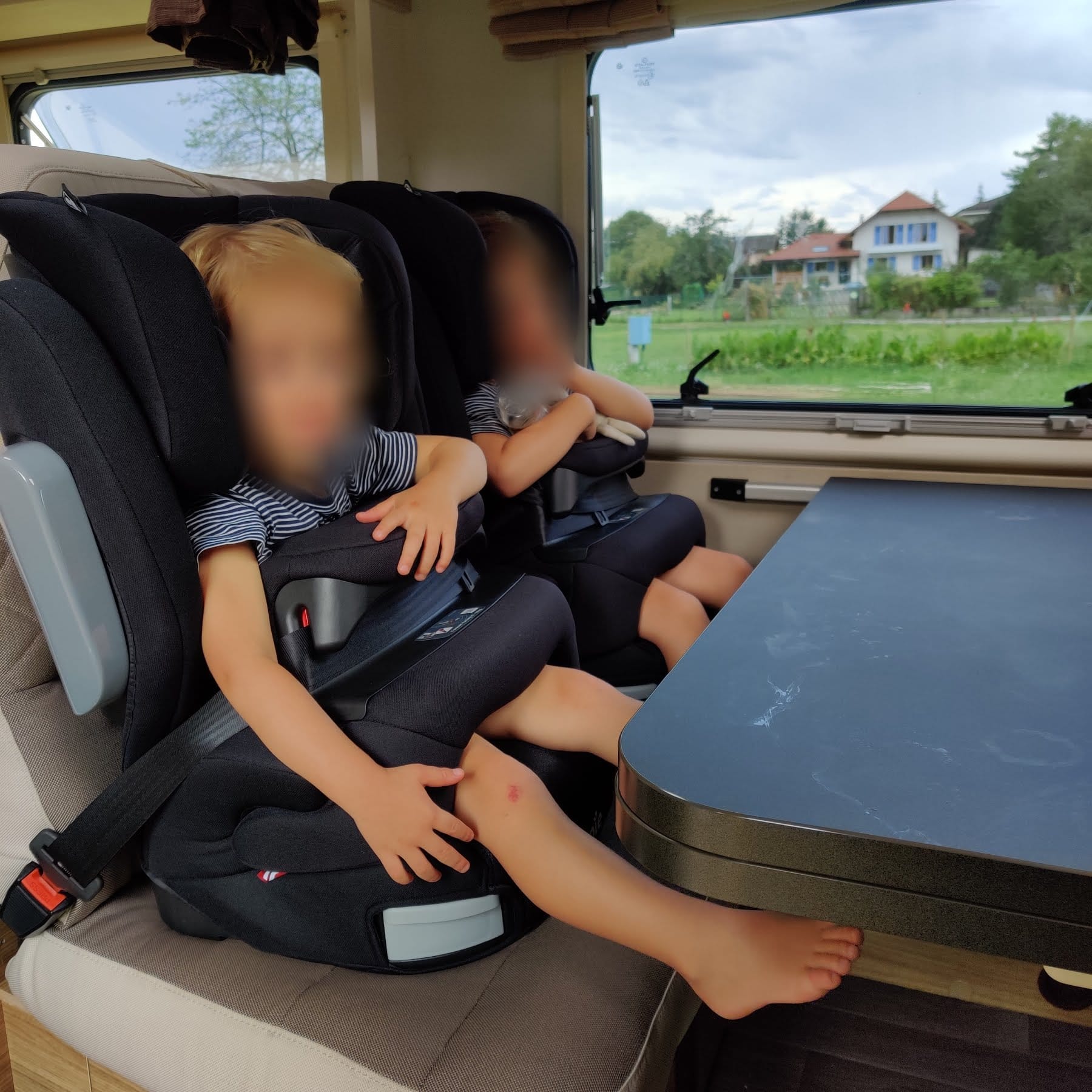
Travelling around Italy by motorhome with children can be a wonderful family adventure. Exploring new places, enjoying nature and stopping in beautiful locations can create unforgettable memories.
However, ensuring the safety of younger passengers during the journey is essential. In Italy, the correct use of child car seats is a legal requirement, and adults are responsible for protecting children while travelling.
Understanding the rules for child seats in motorhomes will help you travel safely and enjoy your trip across Italy with peace of mind — here is everything you need to know before departure.
Are child car seats required in motorhomes in Italy?
Yes. In Italy, child car seats are mandatory in motorhomes, just as they are in cars.
Children must use an appropriate restraint system from their very first journey until they reach 150 cm in height — a height most children reach around the age of 12. Once a child is taller than 150 cm, they may use the standard seatbelt, provided it sits correctly across the chest and pelvis.
Motorhome passengers must also respect the number of approved travel seats indicated on the vehicle registration document. Many motorhomes have more sleeping berths than authorised travel seats, but passengers may only travel in the seats equipped with seatbelts.
Children must always remain seated and secured while the motorhome is moving. It is illegal and extremely dangerous for children to move around the vehicle, lie in beds, or sit on an adult’s lap during the journey.
Isofix in motorhomes: what you should know
Unlike many modern cars, Isofix systems are rarely installed in motorhomes, even in newer models.
If your motorhome does not have Isofix anchor points, child seats must be installed using a three-point seatbelt. Before travelling, check that your motorhome has suitable seatbelts and that the child seat can be installed securely.
European child seat regulations: ECE R44 and ECE R129 (i-Size)
Two European regulations currently apply to child restraint systems:
- ECE R44, based on the child’s weight
- ECE R129 (i-Size), based on the child’s height
Always check that your child seat carries an ECE R44 or ECE R129 approval label. If you already own an ECE R44-approved seat, you are not required to replace it under the newer i-Size regulation.
The i-Size standard improves safety by including side-impact protection and requiring Isofix installation for seats designed for smaller children (up to 105 cm).
Installing a child seat in a motorhome
Choosing the correct seat for your child’s age, height and weight is essential. The child seat must be firmly secured using a three-point seatbelt and should not move excessively once installed. Always follow the manufacturer’s installation instructions carefully.
Safety checklist before departure
- Approved child seat
- Correct installation
- Seatbelt properly tightened
- Airbag correctly managed if using the front seat
Child seats may be installed on the front passenger seat, but if the seat is rear-facing, the airbag must be deactivated.
Can I install a child seat on the dinette seats?
It depends on two conditions. First, those seats must be approved on the vehicle registration document as travel seats and fitted with three-point seat belts; side benches, in particular, almost never are. Second, most child seat manufacturers require installation on a seat facing forward, so even an approved rear-facing seat may not be suitable for the child seat. Always check your child seat manual. If in doubt, the vehicle registration document and the manufacturer’s instructions take precedence.
What about the dinette table? Put it in travel position
In a motorhome, you often travel seated right in front of the dinette table. Under sudden braking or in a collision, your body pitches forward into the table, a rigid obstacle just a few centimetres away. And if the tabletop simply slots into its mount without locking, as in many vehicles, it can come loose and turn into a projectile weighing several kilos. Before setting off, put the table in its travel position: lowered, removed or locked, as specified in your vehicle’s manual. And no heavy or hard objects on the table while driving.
Why rear-facing travel is safer for children
Travelling rear-facing significantly improves child safety. According to Swedish road-safety research, this position can be up to five times safer: in a collision at 50 km/h, a child travelling forward-facing has around a 40% risk of serious injury, while the risk drops to about 8% when travelling rear-facing. Rear-facing seats also provide better support for a child’s head, neck and spine.
In Sweden, widely considered the safest country in the world for child road safety, children commonly travel rear-facing until the age of 4 to 6 years. European safety standards are gradually evolving in this direction.
Choosing the right child seat
Italian law requires children to travel rear-facing:
- up to 9 kg under ECE R44, or
- until at least 15 months under i-Size regulations
However, experts recommend keeping children rear-facing for as long as the seat allows.
Child seat categories
- Group 0 – Carrycots (birth to 10 kg). Installed sideways on rear seats if approved. Many perform poorly in crash tests, so infant carriers are safer.
- Group 0+ – Infant carriers (birth to 13 kg), installed rear-facing.
- Group 1 – Children from 9 to 18 kg. Usually forward-facing seats installed on rear seats.
- Group 2 – Children from 15 to 25 kg. Forward-facing seats with backrest.
- Group 3 – Children from 22 to 36 kg. Booster seats.
Practical example for parents: if your child weighs 37 kg but is only 145 cm tall, they must still use an approved booster seat. The seatbelt alone can be used only once the child reaches 150 cm in height.
Child presence alarm requirement in Italy
In Italy, a child presence alarm (anti-abandonment device) is mandatory for all children up to 4 years old, regardless of their weight or height, in vehicles registered in Italy, or in vehicles registered abroad but driven by residents in Italy. Failure to use such a device may result in penalties under Article 172 of the Italian Highway Code.
Note for foreign travellers: if you hire a motorhome or campervan in Italy with an Italian registration plate, Italian regulations regarding child presence alarms apply. This means that when travelling with children under 4 years old secured in a child seat, you must also use an approved child presence alarm in addition to the child seat.
These devices act as sensors that detect the presence of the child in the seat. If the system detects that the child may have been left in the vehicle, it sends an alert to the parent’s smartphone and, if configured, to additional emergency contacts.
Practical tips for travelling by motorhome with children
- Plan frequent stops: children benefit from regular breaks to stretch and move around — our guide to Italy by motorhome helps you plan a route with the right rhythm;
- Bring entertainment: books, games and films can help keep children occupied and prevent them from unfastening their seatbelt;
- Monitor the temperature inside the motorhome: ensure the interior remains comfortable for young passengers;
- Secure loose objects: unsecured items can become dangerous in the event of sudden braking.
Family-friendly motorhome stopovers with Agricamper
Agricamper, Italy’s farm-stop network, offers unlimited free 24-hour stops at hundreds of farms and wineries across Italy — and many of them are perfect with children: farm animals, orchards and vegetable gardens, outdoor activities in the countryside, authentic rural experiences and in some cases even a swimming pool. After hours in the car seat, children can finally play safely and discover how local food is produced — read more in our article on children, nature and freedom at farm stays, and see our FAQ Is Agricamper suitable for children and families?
👉 Open the free Demo of the Agricamper app and filter the stopovers suitable for families — then plan a safe, child-friendly itinerary across Italy in just a few taps.
Conclusion
Travelling by motorhome with children can be an incredible family experience — their safety during the journey simply comes first. Choose the right seat, respect the rules, and let the destinations do the rest: 👉 discover the Agricamper membership and stop where children are welcome, all across Italy.