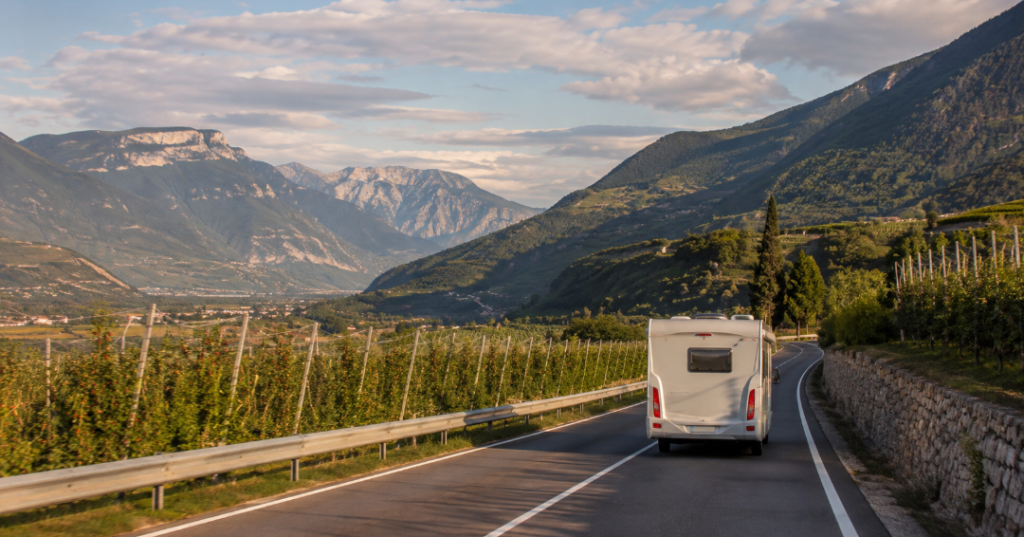
Driving the Brenner Pass by motorhome is one of the simplest ways to enter Italy from Germany, Austria or the Netherlands. The motorway route runs south through Austria and crosses into Italy on the A22, making it a natural gateway towards Bolzano, Trento, Lake Garda and the rest of the country. For a motorhome up to 3.5 tonnes, you need to understand Austria’s vignette and Brenner section toll before you leave; above 3.5 tonnes, a different Austrian toll system applies. Just as important is deciding where you will spend your first Italian night instead of making that decision after a long day behind the wheel.
What tolls do you pay on the Brenner route in 2026?
If your motorhome has a technically permissible maximum laden mass of up to and including 3.5 tonnes, you generally need a vignette to use Austria’s motorways and expressways. In 2026, the 10-day vignette for this vehicle category costs €12.80. The A13 Brenner motorway works differently: it is a special section-toll route and costs €12.50 for a single complete trip.
These are two separate toll systems. The Austrian vignette covers most motorways and expressways, including the A12 Inntal motorway, while the A13 Brenner motorway is subject to a separate section toll. The A13 itself does not require a vignette. However, if you approach the Brenner via the A12, as is common when travelling south from Germany, you will normally need both: a valid vignette for the A12 and the €12.50 section toll for the A13. You can check current prices and rules directly with ASFINAG, the official Austrian motorway operator.
- Motorhome up to and including 3.5 t: a vignette is generally required on Austrian motorway and expressway sections subject to the vignette system.
- 10-day Austrian vignette in 2026: €12.80.
- A13 Brenner section toll in 2026: €12.50 for one complete trip; no vignette is required on the A13 itself.
- Motorhome over 3.5 t: Austria generally uses the distance-based GO toll system, requiring a GO-Box or another authorised onboard unit.
One detail matters if you buy your vignette online shortly before travelling. Digital 1-day and 10-day vignettes can be valid immediately. By contrast, when private consumers buy a digital 2-month or annual vignette online, it can generally only become valid from the 18th day after purchase because of Austrian consumer protection rules. Always check the selected validity date before setting off.
For motorhomes above 3.5 tonnes, check field F.1 on your registration certificate before entering Austria. ASFINAG uses the vehicle’s technically permissible maximum laden mass to determine whether the vignette or GO toll system applies. Vehicles above 3.5 tonnes are generally subject to the kilometre-based GO toll.
There is an important transitional exception for some older vehicles. Until 31 January 2029, certain vehicles first registered before 1 December 2023 may remain in the vignette and section-toll system even if their technically permissible maximum laden mass exceeds 3.5 tonnes, provided they meet ASFINAG’s specific conditions. If your motorhome falls into this category, check the official GO toll guidance before travelling.
What happens after you cross the Brenner into Italy?
Once you cross the border, you join Italy’s A22 Autostrada del Brennero, where the toll is calculated according to the distance travelled and your vehicle class. On the A22, vehicle classification is based on the number of axles and the vehicle’s height at the first axle. For two-axle vehicles, this measurement determines whether the vehicle falls into Class A or Class B; vehicles with more axles are classified accordingly.
Because motorhomes can fall into different toll classes depending on their characteristics, it is better not to estimate the cost from a passenger-car fare. Use the official A22 toll calculator and select your actual vehicle class and entry and exit points before travelling.
From 1 January 2026, A22 toll rates increased by 1.46%, following a period without tariff increases from 2021 to 2025. The motorway is also one of Italy’s major north-south corridors: Autostrada del Brennero reports that more than 70 million vehicles travelled on the A22 in 2025. This makes it worth checking traffic forecasts before departure, particularly around busy weekends and major holiday travel periods.
The Brenner, however, is only the beginning of your journey. If you are planning a longer route through the country, our Italy by Motorhome & Caravan: The Complete Guide covers the practical side of travelling in Italy by motorhome or caravan, from roads and overnight stops to the rules worth knowing before you set off.
Once you have planned the border crossing, the next practical question is where to spend your first night in Italy. Rather than waiting until the end of a long driving day to look for a place to stop, you can plan this first stage in advance. The free Agricamper Demo lets you explore the map before your trip and see the rural stopovers available along your route south from the Brenner, helping you decide how far you want to drive on your first day.
Where should you spend your first night in Italy?
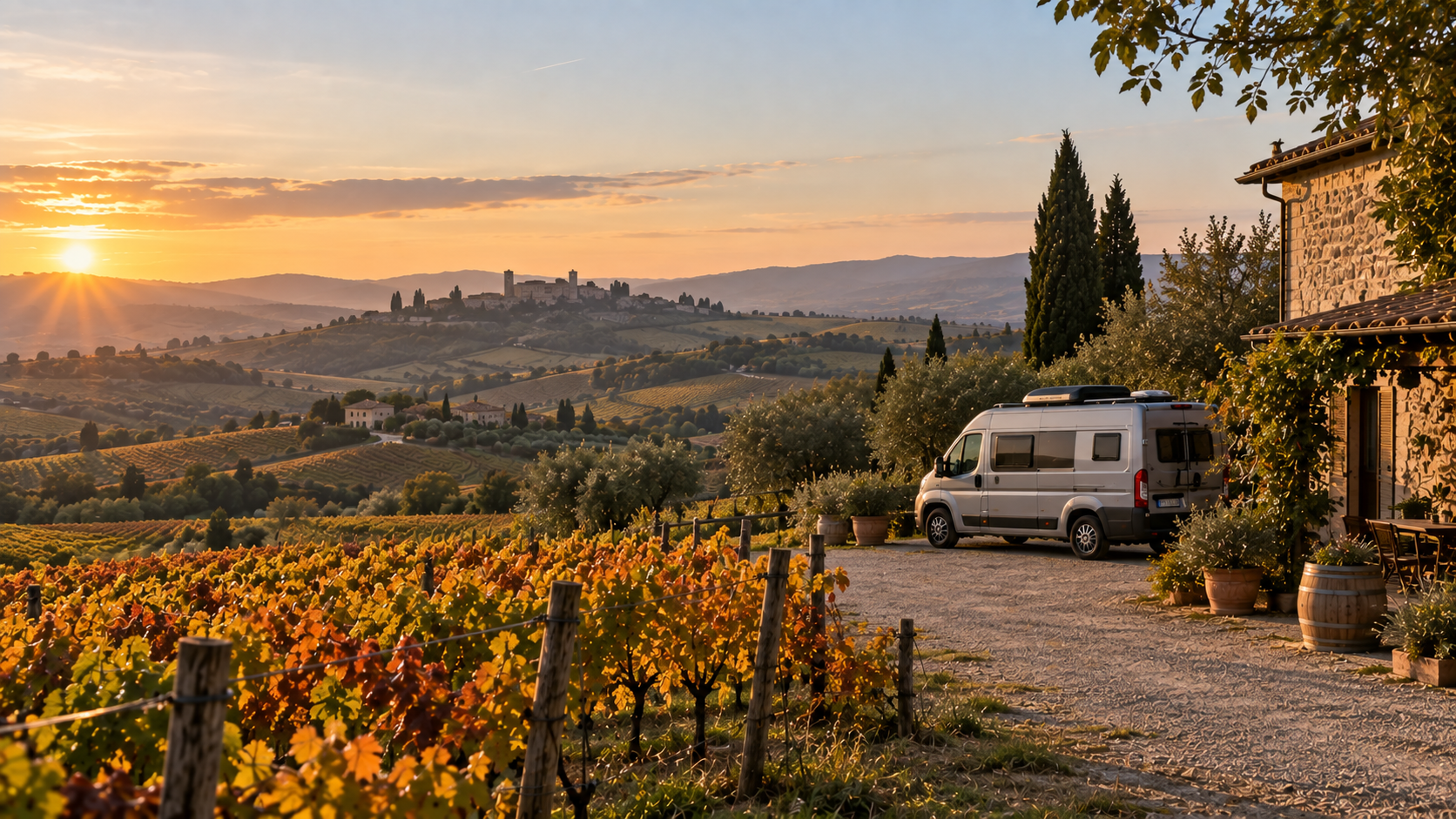
After a full day on the road, your first night in Italy does not have to be spent at a motorway service area. With Agricamper, you can request a rural stop in advance and, once the host has confirmed your booking, arrive knowing where you will spend the night. This can be particularly useful when you enter Italy through the Brenner and want to break your journey before continuing further south.
It is an easy detail to overlook when planning the route. You may have calculated the Austrian vignette, the Brenner toll, fuel and the Italian motorway costs, but after several hours behind the wheel, searching for somewhere to stay is probably the last thing you want to add to the day.
Instead, your first evening can become part of the journey. Agricamper’s network lets you discover rural hosts across Italy, including farms, wineries and other agricultural producers. Agricamper, Italy’s farm-stop network, offers unlimited free 24-hour stops at farms and wineries across Italy. The service is intended for self-contained motorhomes, campervans and eligible caravans. You request each stop through the app and must wait for the host’s confirmation before arriving.
Having a confirmed stop is particularly useful in South Tyrol, where you should not assume that a scenic car park or lay-by can automatically be used for an overnight stay. In January 2026, the Autonomous Province of Bolzano reported that the South Tyrolean Municipalities Consortium and the provincial Department of Agriculture, Forestry and Tourism had developed a model regulation covering parking, camping and other forms of overnight accommodation outside designated areas. Municipalities where wild camping has become a problem were encouraged to adopt it, while several had already introduced measures of their own. You can read the details on the official South Tyrol provincial website.
For this reason, always check local restrictions and road signs rather than assuming that parking also means you may stay overnight. Planning an Agricamper stop and waiting for the host’s confirmation gives you a defined destination for the evening and avoids having to improvise when you arrive.
If you are unsure how an Agricamper stop differs from a campsite, an agricamping facility or a conventional motorhome area, see our article How is Agricamper different from campsites, farm camping and camper stops?. It explains what to expect from a 24-hour farm stop and when another type of overnight facility may be more appropriate for your trip.
Is the Brenner always the best route into Italy?
The Brenner is a convenient motorway route into Italy for many journeys from Germany and Austria, particularly if you are heading towards South Tyrol, Trentino and destinations further south. It is not, however, the only way across the Alps. Depending on where you start, your destination in Italy, the weight of your motorhome and current road conditions, routes via the Reschen Pass, Felbertauern or the A10 Tauern motorway may be worth considering.
Reschen Pass / Passo Resia
The Reschen Pass is a toll-free road crossing that brings you into the Val Venosta area of South Tyrol without using the Brenner motorway. In 2026, however, major works on the Austrian B180 Reschenstraße between Pfunds and Nauders affect this route, so it is important to check the restrictions before choosing it.
This is particularly relevant if you travel in September or October. From 31 August to 30 October 2026, the affected stretch is scheduled to close from Monday to Friday between 08:00 and 18:00. During these closures, traffic is diverted through Switzerland. Motorhomes can use the diversion, but vehicles over 3.5 tonnes are subject to the applicable Swiss lump-sum heavy vehicle charge (PSVA). Before setting off, check the latest restrictions and diversion information on the official South Tyrol Reschen Pass page.
Felbertauern route
If you are approaching through eastern Austria, the Felbertauern route through East Tyrol can provide another way towards northern Italy. The Felbertauernstraße itself does not require an Austrian motorway vignette, but it is a separately tolled road. In 2026, a single trip for a car or motorhome costs €13.50.
Whether this route makes sense depends on your starting point and your destination in Italy, so it is better considered as an alternative Alpine route rather than a direct substitute for the Brenner. Check current tariffs and road information on the official Felbertauernstraße website.
Tauern motorway
The A10 Tauern motorway is more relevant if you approach from the Salzburg area and are heading towards Villach and north-eastern Italy, rather than South Tyrol. The special toll section between Flachau and Rennweg, which includes the Tauern and Katschberg tunnels, costs €15.00 for a single trip in 2026 for vehicles up to and including 3.5 tonnes.
This section toll is separate from the Austrian vignette required on the other motorway sections subject to the vignette system. You can check current tariffs directly with ASFINAG, Austria’s official motorway operator.
There is therefore no single Alpine route that is best for every motorhome journey. Compare your starting point, final destination, vehicle weight, tolls and current road restrictions before deciding whether the Brenner or another crossing makes more sense for your itinerary.
Whichever route you choose, crossing the border is only part of the planning. You also need to know where you can legally park and spend the night once you reach Italy. Before relying on a roadside car park or an informal overnight spot, read our Guide to wild camping in Italy and what the law says to understand the difference between parking, camping and the restrictions you may encounter along your route.
How to plan a calmer September or October arrival
For an autumn trip, it makes sense to plan your border crossing and first overnight stop together. September and October lend themselves well to a slower itinerary, but if you are considering the Reschen Pass in 2026, check the latest road restrictions carefully: works on the Austrian B180 between Pfunds and Nauders affect the route from 31 August to 30 October, with scheduled weekday closures.
Before leaving, check your motorhome’s technically permissible maximum laden mass (field F.1 on the registration certificate), make sure you have the correct Austrian toll product for your vehicle and route, and check for any current road restrictions. Then decide how far into Italy you actually want to drive on your first day. If your final destination is Tuscany, Umbria or Puglia, you do not necessarily need to cover as much distance as possible immediately after crossing the Alps.
A planned overnight stop in Trentino-Alto Adige can turn the border crossing into a natural first stage of the journey. Instead of continuing south after a long day on the road, you can head to your confirmed overnight stop, enjoy the evening and continue your journey the following morning.
This approach can work particularly well on a three- or four-week trip. Rather than treating northern Italy simply as somewhere to drive through, you can make your first stop part of the experience and settle into a slower rhythm from the beginning.
If this is your first motorhome journey in the country, it is also worth checking the main rules for driving in Italy with a motorhome or caravan before crossing the border, so you know what to expect on Italian roads from your first day onwards.
Frequently asked questions about driving the Brenner Pass by motorhome
Do I need a vignette for Austria in a motorhome?
Yes, if your motorhome has a technically permissible maximum laden mass of up to and including 3.5 tonnes, you generally need a vignette on Austrian motorways and expressways subject to the vignette system. In 2026, the 10-day vignette costs €12.80. Motorhomes over 3.5 tonnes are generally subject to Austria’s distance-based GO toll system instead.
How much is the Brenner toll in 2026?
The complete A13 Brenner motorway section costs €12.50 for a single trip in 2026 for vehicles up to and including 3.5 tonnes. The A13 itself does not require a vignette because it is subject to a separate section toll. However, if you approach the Brenner via the A12 Inntal motorway, you will normally also need a valid Austrian vignette for the A12. Once you enter Italy, the A22 toll is calculated according to the distance travelled and your vehicle class.
Where can I spend my first night after crossing into Italy?
You can request a rural stop with an Agricamper host in advance, giving you a planned destination for your first night in Italy. Agricamper has hosts across the country, including northern Italy, making it possible to include a rural stop as the first stage of your journey south. Send your stay request through the app and always wait for the host’s confirmation before arriving.
Is the Reschen Pass free?
Yes, the Reschen Pass road itself is toll-free, but roadworks and scheduled closures affect the route in 2026. From 31 August to 30 October 2026, the affected section of the Austrian B180 between Pfunds and Nauders is scheduled to close from Monday to Friday between 08:00 and 18:00, with traffic diverted through Switzerland. Motorhomes can use the diversion, but vehicles over 3.5 tonnes are subject to the applicable Swiss lump-sum heavy vehicle charge (PSVA).
Do I need a GO-Box for a 3.5-tonne motorhome?
No. If your motorhome has a technically permissible maximum laden mass of exactly 3.5 tonnes, it is not subject to Austria’s standard GO toll system. It generally uses the vignette system and pays separate section tolls where applicable. The GO toll normally applies to vehicles over 3.5 tonnes. Check field F.1 on your registration certificate, as this is the technically permissible maximum laden mass used to determine which Austrian toll system applies.
Your first Italian night can be part of the journey
The Brenner is not difficult to plan once you separate the journey into three questions: which Austrian toll system applies to your motorhome, what will you pay on the A13 and A22, and where will you stop once you enter Italy. Answer the last question before departure and your first evening can feel like the beginning of the holiday rather than the end of a motorway day.
If rural stopovers fit the way you travel, discover the Agricamper Italia membership. It provides 12 months of access to the digital guide and app and unlimited free 24-hour farm stopovers for eligible self-contained vehicles across Italy.