The good news first: according to the most comprehensive accident study carried out in Europe, by the German insurers’ research body, motorhomes are involved in fewer than 0.2% of injury accidents. Travelling this way is statistically one of the safest holidays on the road. But a motorhome is not a big car: it weighs more, needs longer to stop, catches the wind and carries an entire household behind the seats. This guide takes the risks that really matter, the vehicle, the weight, the loading, the driving, the season, and turns them into concrete habits, wherever the road takes you.
Panel van, semi-integrated or A-class: what the crash tests say
There is no consumer crash test for finished motorhomes yet, but the Swedish Transport Administration tested a semi-integrated and an A-class, and the ADAC crash-tested a camper van. Their shared finding: a short crumple zone relative to the weight, and frontal protection below that of a modern car. From most to least protective in a crash:
- The camper van: the body is 100% the manufacturer’s, only the interior is converted. The most protective, but the added furniture is the weak point (in the ADAC test: kitchen unit torn loose, rear bench collapsed);
- The semi-integrated: manufacturer’s cab, living cell built by the converter. Good protection up front, less in the cell;
- The A-class: the converter builds everything, cab included. The most spacious, but without the reinforcements of a manufacturer’s cab: the weakest result in the Swedish test.
A case apart, the caravan: its passengers travel in the towing car, the best crash protection there is. In exchange, an outfit is more demanding to drive (snaking, crosswind, reversing): its safety depends more on the driver. No statistics separate caravans and motorhomes overall.
The base vehicle, on the other hand, can be compared in black and white: since 2021, Euro NCAP has been rating the vans that motorhomes are built on, and the differences are real even between well-rated vehicles. Before buying or renting, check the rating and model year of the base vehicle, and prioritise automatic emergency braking.
An encouraging note: in the ADAC crash test, the child in an Isofix seat with Top Tether came through well, and the load strapped to the lashing points held. The right habits work.
👉 Open the free Demo of the Agricamper app and discover hundreds of farms and wineries across Italy waiting for your next stopover.
What the accident data really says
The most frequent motorhome accident, according to that same German study, is the motorhome hitting the vehicle in front: a braking distance judged like a car’s, with a considerably heavier vehicle. The countermeasure exists, it is free, and it is further down this guide.
Second finding: in roadside checks, more than half of the motorhomes exceeded their maximum permitted weight, and according to the investigators, most drivers were not aware of it. Overweight is the most widespread risk factor, and the most discreet.
Third finding, from the official EU road safety report: the most serious accidents are concentrated outside built-up areas (more than half of all cases, against just 8% on motorways), with peaks on Saturdays, in summer, between 3 pm and 5 pm.
Last lesson: among vehicle occupants killed in Europe, 44% die in a crash involving no other road user, a loss of control followed by running off the road, and the large majority of deaths occur away from junctions. Vigilance is therefore not only about the traffic around you: the driving itself, speed, distances, the driver’s condition, weighs at least as much.
Weight: the number one safety factor
An overloaded motorhome needs a longer distance to stop, holds the road less well through bends and wears its tyres unevenly, whether you drive a camper van, a 3.5-tonner or a heavy motorhome, where the rules are stricter still.
Weigh your motorhome once, fully loaded: family on board, water, gas, bikes, everything. Where? There is no official directory of public weighbridges, but they are easier to find than you might think: agricultural cooperatives, builders’ merchants, recycling centres and wholesale markets almost always have one. In Italy, expect to pay around 2 to 6 euros. Weigh once, and you know your real margins for the life of the vehicle.
Then distribute: heavy items low and between the axles, the water tank only as full as you need, grey water emptied before departure. A low centre of gravity is what keeps a motorhome stable through bends and in the wind.
Inside the motorhome: everything secured, every departure
In a crash, a loose object develops a force equal to several dozen times its weight. The rule fits in one sentence: nothing heavy travels up high or loose. In practice:
- Heavy things down low: bottles, tools, tins and supplies in the bottom drawers and under the benches. Never in the overhead lockers: in a crash their contents fall onto the occupants, and all that weight up high hurts stability;
- As little glass on board as possible: jars and bottles turn into shards, and whatever does travel in glass goes down low, in a closed compartment;
- Check that every latch really clicks: a push-lock can look closed without being locked. Press and pull to test, engage the fridge travel lock, close the gas bottles;
- Dinette table in travel position: lowered, removed or locked, as specified in the vehicle manual. A tabletop that is simply slotted in can come loose in a crash;
- The garage is not a magic box: even separated from the cell, strap bikes and heavy items to the lashing points. In a crash, a loose load is thrown forward with a force the partition wall is not designed to hold;
- Beds carry blankets, not cargo: a mattress will not hold back a suitcase in a crash;
- Dogs and cats travel secured too: in a fixed transport crate or with an approved harness attached to a belt point, never loose in the cell.
And of course: every passenger seated and belted on an approved travel seat, a seat belt cuts the risk of death by up to 50% according to the WHO, and children in their car seat, a device that reduces mortality among the youngest by 71%: all the rules in our FAQ on child car seats in motorhomes.
Driving a motorhome: the rules that do the real work
Double your following distance. The gap you keep in a car, multiplied by two, and allow even more in a heavy motorhome. It is the single most effective habit, because it neutralises exactly the most frequent accident: braking too late on the vehicle ahead.
Drive at motorhome speed. 100-110 km/h on the motorway is the right cruising rhythm: more stable, more restful, and your fuel bill will thank you. This is not zeal: according to the WHO, every 1% increase in average speed raises the risk of a fatal crash by 4%. A few km/h less is a far bigger safety gain than it looks. In a heavy motorhome, limits are lower (often 80 km/h on motorways depending on tonnage and country) and, in Italy, reflective speed stickers at the rear are mandatory above 3.5 t.
Watch out for crosswind. A motorhome is tall and light for the surface it exposes. The real danger of a gust: being pushed half a metre sideways at full speed. Be alert on viaducts, leaving tunnels, overtaking trucks, and check wind warnings before passes and coastal stretches. When in doubt, slow down or stop.
Know your dimensions by heart. Height, width, length: put them on a note on the dashboard. The classic traps: low bridges, car park height bars, petrol station canopies, toll gates with gauges, tunnels on secondary roads. When in doubt, stop rather than try. And when reversing, visibility is very limited: have a passenger get out and guide you, every time.
At night and at dawn, think of wildlife. Deer and wild boar cross mostly at dusk, outside built-up areas. If eyes glow at the roadside: switch to dipped beam (dazzled by full beam, animals freeze), sound the horn, and if the animal appears, brake hard in a straight line, never swerve: in a motorhome, the evasive manoeuvre is more dangerous than the impact.
Alcohol and medicines: the driver prepares too. The alcohol limit is 0.5 g/l in most European countries (0.0 in Italy for novice and professional drivers), and the risk climbs from the first drinks. The blind spot is medicines: sleeping pills, antihistamines and some painkillers impair alertness without you feeling it. The reflex: check the warning on the box or leaflet, and ask the pharmacist before a long trip.
And the driver? Fatigue and distraction are among the leading causes of accidents in Europe. The phone stays in its cradle: at the wheel, it multiplies the risk of an accident by 4 according to the WHO. And the professionals’ rule: a real break every two hours of driving. In a motorhome it is easy to keep: the stop is part of the journey.
Country roads: at the right rhythm, not in transit
Country roads are not dangerous in themselves: it is transit speed that creates the risk there. The serious accidents outside built-up areas are the overtakes, the junctions taken too fast, the night on unknown roads.
The motorhome strategy is simple: the motorway for long transfers, and country roads for what they offer best, short stages, at a slow rhythm, driven rested, with landscapes admired in full daylight. Set your vehicle’s real height, weight and length in your navigation app so it never sends you down a shortcut built for cars.
And arrive early: an afternoon arrival means a nap under the awning, a farm tour with the children, an aperitif with the producer, and a driver who sets off the next morning fresh and rested.
Every season has its rules
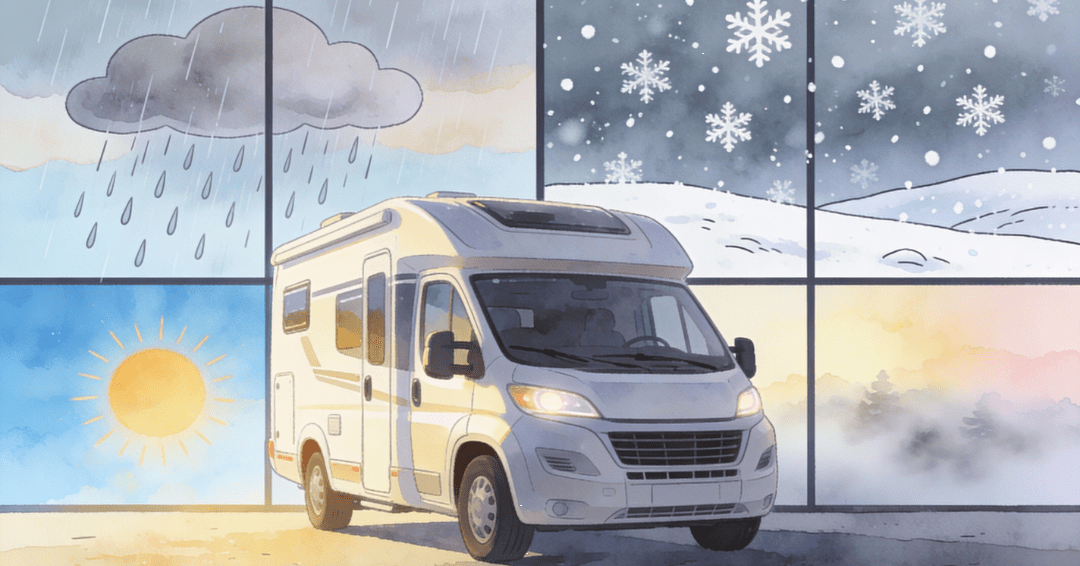
Summer: heat is hard on tyres. Fit tyres with the C or CP marking intended for your vehicle (check against the registration document), in classic summer or all-season version. Check pressures cold before every long stage, and check the age on the sidewall (the DOT code gives week and year of manufacture): motorhome tyres age even when parked. Inspection from 6 years, replacement recommended around 6-8 years according to ADAC and TÜV.
Winter: winter tyres or chains on board where required, mind the weight of snow on the roof, and choose the main passes, better maintained and less steep.
Autumn and spring: wet leaves, heavy rain, aquaplaning. With 3.5 tonnes, standing water deserves respect: slow down and open the distances further.
Think about fire risk too. A motorhome concentrates gas, electricity and bedding. The basics: a fire blanket near the kitchen, the most effective response to a flaming pan, and an extinguisher within reach near the door. Careful if your route crosses a country where an extinguisher is required, such as Greece or Poland: you then need a classic EN 3 approved model. As a complement for the interior, the potassium aerosol extinguisher is a clever solution: 500 grams, a claimed effectiveness comparable to a classic extinguisher on gas, electrical, cooking oil and plastics fires, and above all no residue, where powder destroys the whole cell. Finally, gas and electrics are not for tinkering: any work on these systems goes through a professional.
Documents, vests, warning triangle and mandatory equipment: it is all in our complete guide to Italy by motorhome and caravan.
The 2-minute checklist before every departure
- Tyre pressures checked (and DOT age known)
- Extinguisher valid and within reach + fire blanket
- Load distributed, nothing heavy up high
- Garage strapped, table in travel position
- Latches, fridge, gas: pressed and tested
- Weather and wind checked on today’s route
- Navigation set to real dimensions, sizes displayed on the dashboard
- First break of the trip in mind
- Everyone belted, children in seats, pets secured
FAQ: motorhome road safety
Where can I weigh my motorhome?
There is no official directory of public weighbridges, but agricultural cooperatives, builders’ merchants, recycling centres and wholesale markets almost always have one; in Italy expect 2 to 6 euros. Weigh once fully loaded, family, water, gas and luggage included, and you know your real margin for good.
How old can motorhome tyres be?
There is no legal age limit for motorhome tyres, but experts recommend an inspection from 6 years and replacement around 6-8 years, even with good tread, because tyres age while parked. Read the age from the DOT code on the sidewall, and fit C or CP marked tyres as specified for your vehicle.
Do passengers have to wear seat belts in the living area?
Yes. Everyone travels seated and belted on the approved travel seats listed in the registration document, with no exceptions while driving. Beds and side benches are not travel seats, and children need approved car seats: see our FAQ on child seats in motorhomes.
How should dogs travel in a motorhome?
Always secured: in a fixed transport crate or wearing an approved harness attached to a belt point. A loose dog is a danger to itself and to everyone on board, and must never ride on laps or roam the living area while the vehicle is moving.
Which motorhome type is the safest in a crash?
Based on the available crash tests, the camper van protects best (full manufacturer body), followed by the semi-integrated (manufacturer cab) and the A-class (converter-built cab). The caravan is a case apart: passengers travel in the towing car, the best protection there is, but the outfit demands more of the driver.
Travel at the Agricamper rhythm
There is a way of travelling where all of this becomes natural: short stages, landscapes admired in full daylight, afternoons among the vines and evenings with producers who open their table to you. It is the journey as we love it: slow, curious, full of flavour. 👉 Discover the Agricamper membership and travel at the rhythm that protects: the rhythm of the countryside. Most of these rules, by the way, apply to any vehicle, your car included.