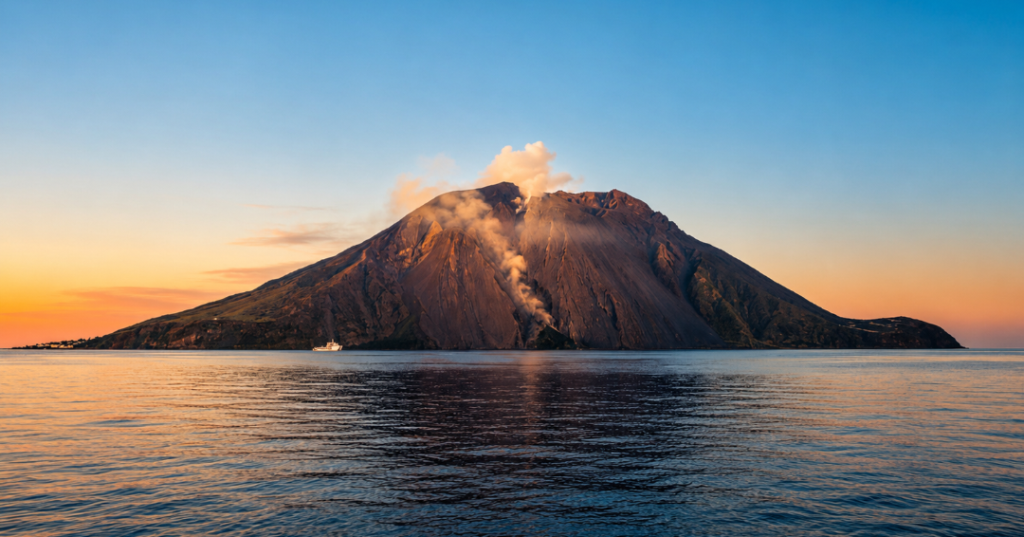
Italy is one of the European countries with the richest and most fascinating volcanic heritage. When people talk about Italian volcanoes, Etna, Vesuvius and Stromboli usually come to mind first, but the story is much broader than that. Over thousands of years, volcanic activity has shaped mountains, islands, lakes and landscapes that are now among the most spectacular destinations to visit during a trip to Italy.
For those who love exploring the country by motorhome, campervan or caravan, an itinerary dedicated to Italy’s volcanoes offers a wide variety of experiences. You can walk along trails that cross ancient lava flows, admire active craters, visit world-famous archaeological sites and relax on the shores of lakes formed by eruptions that took place thousands of years ago.
Moreover, thanks to Agricamper, you can make your journey even more authentic by choosing peaceful nature stopovers at farms and rural businesses throughout Italy.
So let’s set off on an itinerary through volcanic Italy, from great active volcanoes to ancient craters transformed into lakes and protected natural areas.
Vesuvius and the Phlegraean Fields – Where history, archaeology and volcanoes meet
Few places in the world combine history and geology as powerfully as the area around Vesuvius and the Phlegraean Fields.
Vesuvius is famous for the eruption of 79 AD, which destroyed Pompeii and Herculaneum. Today, it is one of the most visited destinations in southern Italy. The trail leading to the Gran Cono allows you to see the crater up close and enjoy an extraordinary view over the Gulf of Naples.
At the foot of the volcano lie Pompeii and Herculaneum, two unique archaeological sites that allow you to take a real journey back in time. Naples is also well worth a visit, with its rich heritage of monuments, museums and traditions.
Not far away lies the area of the Phlegraean Fields, a vast volcanic caldera that still shows geological phenomena such as bradyseism today. Here you can visit Lake Avernus, considered by the ancients to be the entrance to the Underworld, explore the Archaeological Park of Cumae and admire the fascinating Underwater Archaeological Park of Baia.
For those who love walking outdoors, there are also panoramic trails crossing unique volcanic landscapes and viewpoints overlooking the sea.
Etna – The giant of eastern Sicily
At over 3,300 metres high, Etna is the highest active volcano in Europe and one of the symbols of Sicily. Its presence dominates the entire eastern coast of the island, creating a unique landscape where the black of the lava alternates with the green of the woods and the blue of the sea.
One of the best-known access points is Rifugio Sapienza, where numerous trails and routes begin, allowing you to explore the volcano. Among the most visited attractions are the Silvestri Craters, which are easy to reach even for families, and the Schiena dell’Asino Trail, which offers magnificent views over the Valle del Bove.
If you would like to learn more about the area, you can visit lava caves formed during ancient eruptions or discover the geological history of the volcano through dedicated museums.
The Etna area also offers many interesting places to visit. Catania charms visitors with its historic centre built from lava stone and its splendid Piazza Duomo. Taormina wins travellers over with its Ancient Theatre and sea views. Acireale, Zafferana Etnea and Nicolosi are also excellent starting points for exploring the slopes of the volcano.
Stromboli and the Aeolian Islands – The volcano that lights up the Mediterranean
Among all Italian volcanoes, Stromboli is probably the most spectacular. Located in the Aeolian archipelago, it is known for its almost continuous activity, which has produced striking explosions visible even from far away for centuries.
Walking through the small village of Stromboli, you can discover an authentic and relaxed atmosphere. Spiaggia Nera, the village centre and the Sciara del Fuoco are some of the island’s main attractions.
A guided hike towards the higher slopes of the volcano is one of the most exciting experiences you can have in Italy. Alternatively, you can watch the eruptions from the sea by joining a boat trip, especially atmospheric at sunset.
Stromboli is also an ideal starting point for visiting the other islands in the archipelago. Lipari offers beautiful views and an interesting historical heritage. Salina is known for its lush nature. Panarea charms visitors with its crystal-clear waters and elegant atmosphere.
The island of Vulcano also deserves a special mention. Its name comes from Vulcan, the Roman god of fire, and it was this island, known since ancient times for its geothermal activity, that gave rise to the term now used in many languages to describe these geological phenomena. Here you can admire landscapes shaped by geothermal activity and dark-sand beaches.
The volcanic lakes of Lazio – Ancient craters turned into picture-perfect landscapes
Not all Italian volcanoes are still active. Some, after ending their activity, left behind beautiful lakes that are now ideal destinations for nature lovers and outdoor tourism.
Lake Bolsena is the largest volcanic lake in Europe. Its clear waters, the historic villages of Capodimonte and Marta and the many outdoor activities available make it a perfect destination for motorhome travellers.
Lake Bracciano, located not far from Rome, is famous for its beaches, cycling routes and the magnificent Odescalchi Castle.
Smaller but just as fascinating, Lake Vico is surrounded by a nature reserve rich in trails, woods and birdwatching areas.
These lakes are ideal stops for alternating visits to great active volcanoes with moments of relaxation and tranquillity.
Monte Vulture – The extinct volcano of Basilicata
Among the lesser-known yet most surprising destinations in volcanic Italy, we finally find Monte Vulture, an ancient volcano located in northern Basilicata.
The area is characterised by lush nature, extensive woods and landscapes very different from those usually associated with volcanoes. The Monticchio Lakes, formed inside the ancient crater, are among the main attractions of the area.
The Abbey of San Michele, built on the slopes of the volcano, is also worth a visit, as is the village of Melfi with its impressive castle.
For those who love hiking, the area offers numerous trails through forests, hills and panoramic viewpoints from which to admire the whole Vulture area.
Conclusion
Volcanic Italy is not only about active craters and spectacular eruptions. It is a mosaic of landscapes, lakes, islands, natural parks, historic cities and traditions that tell the story of millions of years of geological evolution.
Travelling by motorhome, campervan or caravan, you can move from the slopes of Etna to the shores of Lake Bolsena, from the trails of Vesuvius to the explosions of Stromboli, discovering a surprising and often lesser-known side of Italy.
Thanks to Agricamper, you can also make your journey even more authentic by choosing a nature stopover at farms along your itinerary. The stopovers available within the network allow you to experience each area from a different perspective and connect with local traditions.
Before setting off, download the Agricamper app and try the free demo version to discover the service’s features. Afterwards, you can purchase your membership and access hundreds of available parking spaces in Italy.
Set off to discover Italy’s volcanoes and turn your next journey into an unforgettable adventure.