Carnival in Sardinia is not just about confetti and colorful floats. Here, among mountains, plateaus, and stone villages, carnival is an ancient, powerful, and mysterious ritual. It is a celebration rooted in pastoral and pagan traditions, still experienced today with great intensity by local communities.
If you travel by motorhome, campervan, or caravan, this is one of the most fascinating times to plan a trip to Sardinia. The roads are quiet and the atmosphere in the villages feels authentic. You can also alternate carnival festivities with beautiful excursions across Sardinia, discovering nature, archaeology, and small historic towns.
Carnival in Sardinia between ancient rites and timeless villages
The most evocative festivals and what to see nearby
The Sardinian carnival is very different from those in large cities. Here you will not only find colorful parades, but also unsettling masks, ringing bells, galloping horses, and rituals that tell the island’s deepest stories.
Each area has its own carnival, with different symbols, costumes, and meanings. That is why travelling by motorhome or caravan during this period is perfect: you can move slowly from one village to another and discover completely different traditions within just a few kilometers.
Mamoiada and the mamuthones
The most iconic carnival in Sardinia
In the heart of Barbagia, among hills and vineyards, the small village of Mamoiada preserves one of the most fascinating and mysterious carnival rituals in Europe. Here, carnival is not a folkloric show for tourists, but a deeply felt tradition passed down from generation to generation.
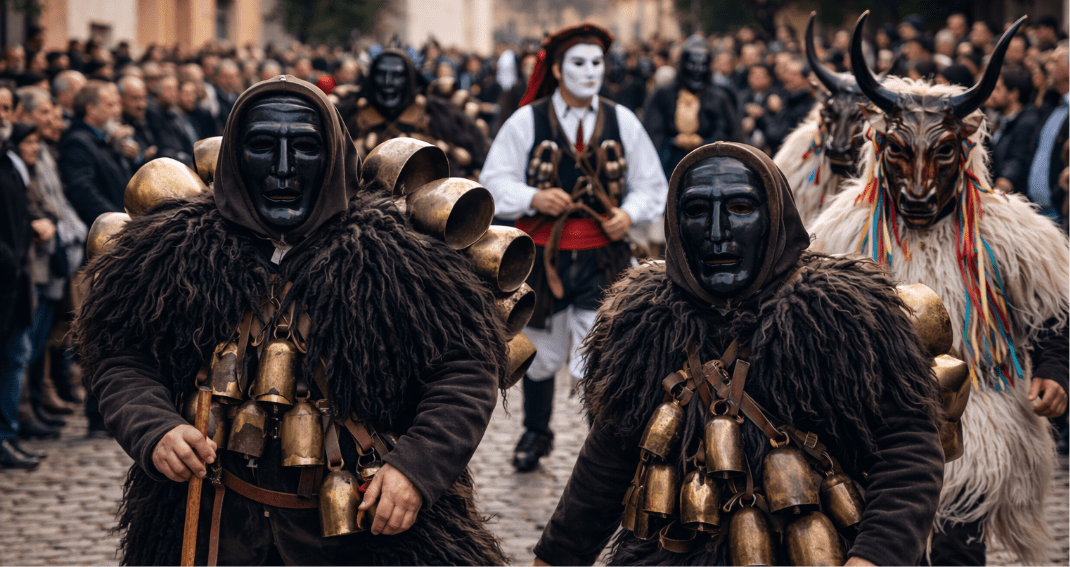
The main characters are the mamuthones and the issohadores. The mamuthones wear dark wooden masks with severe, expressionless faces and are wrapped in heavy black sheep skins. On their backs they carry a series of large bells that can weigh more than thirty kilos. Their steps are slow, rhythmic, almost hypnotic. They move together in synchronized motions, creating a deep, resonant sound that echoes through the village streets.
Beside them are the issohadores, dressed in red jackets, white shirts, and light-colored masks. Unlike the mamuthones, they move lightly and swiftly. In their hands they hold a rope, called a soha, with which they symbolically capture people from the crowd. According to tradition, this gesture brings good luck and represents fertility, prosperity, and abundance.
The origins of this ritual are ancient and still shrouded in mystery. Some scholars link it to agricultural and pastoral rites meant to ensure a good season, while others connect it to pre-Christian celebrations intended to drive away evil spirits and welcome the return of spring. In any case, watching the mamuthones procession is not like attending a typical carnival. It is an intense, almost solemn experience that reveals the deep strength of Sardinian traditions.
After the procession, you can visit the Museum of Mediterranean Masks in Mamoiada, where masks from different regions of Sardinia and other European countries are displayed. The exhibition helps you understand the symbolic meaning of the masks and the connection between carnival rituals and rural life.
Oristano and the Sartiglia
Galloping horses and stars to spear
On the western coast of Sardinia, Oristano celebrates carnival in a spectacular and solemn way with the Sartiglia, one of the oldest and most fascinating equestrian tournaments in the Mediterranean. Its origins date back to medieval times, likely influenced by Spanish rule, and the event still preserves a ritual and almost sacred atmosphere.
The Sartiglia takes place on Carnival Sunday and Tuesday, transforming the historic center into a grand stage. The main figure is Su Componidori, a mysterious and almost regal character. He is dressed in a precise ritual called the vestizione, during which he wears a richly decorated costume and an expressionless white mask. From that moment on, he is no longer a person but a symbol, representing good fortune for the year ahead.
The star race is the most anticipated moment. Riders in traditional costumes and elegant masks gallop down the main street of the historic center, trying to spear a metal star suspended above the road. The more stars they capture, the more prosperous the year is believed to be for the city and the surrounding territory.
After the race, the celebration continues with the spectacular pariglie. Riders perform acrobatic stunts on galloping horses, forming human pyramids and figures. It is an exciting moment where tradition, skill, and courage merge into a unique spectacle.
If you love nature and archaeology, you can continue to the Sinis Peninsula, just a few kilometers from Oristano. Here you will find the archaeological site of Tharros, an ancient city founded by the Phoenicians and later expanded by the Romans, overlooking the sea. Nearby you will also find the beach of Is Arutas, famous for its sand made of tiny white and colorful quartz grains. Even in winter, the landscape is spectacular and perfect for a seaside walk.
Tempio Pausania and the Gallura carnival
Colorful parades in the heart of Gallura
In northern Sardinia, in the heart of Gallura, Tempio Pausania hosts one of the liveliest and most popular carnivals on the island. Here the atmosphere is very different from the archaic rites of Barbagia: the Gallura carnival is colorful, ironic, and embraced by the entire community.
The streets of the historic center, lined with light gray granite houses, become the stage for allegorical parades, music, and open-air celebrations. The floats humorously portray current events, local characters, and social themes, creating a cheerful and engaging atmosphere.
The main figure is King George, a symbolic character representing the spirit of carnival. He is a grotesque and amusing figure, often depicted as a somewhat decadent ruler who loves life’s pleasures. During the festivities, King George is celebrated with parades, performances, and theatrical moments.
At the end of carnival, however, comes the most symbolic moment. King George is put on trial in the main square, accused of all the vices and excesses of the past year. After the verdict, the effigy is burned in a large bonfire. This ritual marks the end of carnival and the return to everyday life, but also represents symbolic purification and a new beginning.
Tempio Pausania is not only about carnival. The town is surrounded by hills and forests and is a perfect base for excursions into Sardinia’s nature. Just a few kilometers from the center, you can head toward Mount Limbara, one of the main massifs in the north of the island. Here you will find several trails through cork oak and holm oak forests, ideal for a quiet walk or a scenic hike. From the higher areas, you can enjoy wide views over Gallura and, on clear days, even glimpse the coast.
Ottana and the traditional masks
The most archaic and evocative carnival
In the heart of the province of Nuoro, surrounded by open countryside and plateaus, the village of Ottana preserves one of the oldest and most symbolic carnivals in Sardinia. Here the celebration is neither light nor ironic: it is a powerful, almost theatrical ritual that reflects the deep connection between humans, animals, and the land.
The main figures of Ottana’s carnival are the boes and the merdules, masked characters who parade through the streets accompanied by the sound of bells. The boes wear dark wooden masks, hand-carved to resemble ox faces with intense, almost unsettling expressions. They carry sheep skins on their heads and heavy bells on their bodies, producing a deep sound with every step.
Beside them are the merdules, representing the shepherds. They wear simpler masks and carry sticks or ropes. During the procession, they try to guide and control the boes, creating a dynamic and symbolic scene. The boes rebel, move erratically, and shake their bells, while the merdules attempt to restrain them.
The atmosphere during the procession is intense and evocative. The streets fill with the sound of bells and the movements of the masks, creating a scene that feels almost outside of time. There is no modern music or decorated floats: everything revolves around the ritual, the masks, and their symbolism.
In the surrounding area, the landscape is wide and silent. The plateau of Abbasanta, not far away, offers green expanses, pastures, and quiet roads, perfect for a nature break during your motorhome travels. It is an ideal area for those seeking authenticity and open spaces, far from the main tourist routes.
What to taste during the Sardinian carnival
Traditional sweets and seasonal flavors
During your trips around Sardinia in carnival season, you will find many typical sweets prepared for the occasion.
Among the most common are zippole, long, fragrant fritters flavored with orange or lemon zest, often scented with local spirits. In some areas they are called frisgioli or cattas.
You will also find orillettas, thin strips of fried dough covered in honey, and tiliccas, pastries filled with almond paste and orange peel.
These flavors reflect the island’s rural traditions and make carnival even more special for travellers exploring by motorhome.
Conclusion
Carnival in Sardinia is an intense and unique experience. It is not just a celebration, but a journey into the island’s deepest traditions.
If you travel by motorhome, campervan, or caravan, you can create a truly special itinerary: one day you watch the mamuthones procession, the next you follow the Sartiglia, and then you stop at a farm or winery to relax in nature and silence.
With agricamper, you can enjoy unlimited free 24-hour stopovers at farms all across Italy. It is the perfect solution for motorhomers and travellers who love direct contact with local territories.
Before you leave, download the Agricamper app and try the free demo version. You can explore the map, see where the stopovers are, and start dreaming about your next journey.
When you are ready, purchase the annual membership and set off to discover the most authentic side of Italy, among rural landscapes, local traditions, and unforgettable encounters.