On November 21st, we celebrated World Tree Day — a perfect moment to reflect on the importance of protecting the landscapes we love to explore on our motorhome or caravan journeys. It’s also the ideal excuse to plan your next stop surrounded by nature — perhaps right next to one of these extraordinary green monuments.
These silent giants are scattered all over Italy, from north to south. They tell stories spanning centuries — even millennia — and accompany us on adventures that reveal a greener, more authentic Italy deeply rooted in nature.
Let’s explore some of the most fascinating monumental trees in Italy, following an ideal route from north to south: a slow, meaningful and green journey, perfect for those travelling by motorhome or caravan.
Italy’s Monumental Trees
Monumental trees aren’t just “big trees.” They are unique beings, known for their age, size, shape, legends or ecological value. Many have witnessed historic events or inspired local myths that live on today. In this section, we’ll take you to discover some of the most iconic examples — with tips on the surrounding areas — ideal for those planning meaningful and slow stopovers across Italy.
1. Northern Italy: where forests merge with the mountains
Northern Italy is a dream for those travelling by motorhome, caravan or campervan in search of unspoilt nature and wild landscapes. Here, monumental trees are more than botanical wonders — they are part of the Alpine identity, shaping valleys, guarding trails, and marking ancient routes.
The millennial larch of Val d’Ultimo (Trentino-Alto Adige)
In the deep tranquillity of the Val d’Ultimo, one of the most untouched valleys in Trentino-Alto Adige, you’ll find three monumental larches, considered among the oldest trees in Europe. The most famous, often called “the millennial larch”, is well over 2,000 years old — older than the Roman Empire at its height, rooted in an era when Alpine people lived off herding and local trade.
Seeing it up close is breathtaking. Its trunk is huge and gnarled, shaped by centuries of harsh winters and fierce winds. The thick, cracked bark reads like the pages of an ancient book. The powerful branches reach slowly upward, like arms stretching for the light through the forest’s silence.
The plane tree of Giardini Estensi (Varese, Lombardy)
In the elegant Giardini Estensi, one of the most refined historic parks in Lombardy, lives a monumental plane tree that has reigned for over two centuries. Planted in the 18th century, it’s now a green symbol of the city: a gentle giant welcoming visitors and curious passersby with its majestic canopy.
In summer, its shade becomes a natural lounge, perfect for sitting and soaking up the peaceful park. In autumn, its golden leaves transform the scene into a movie-like setting full of colour and depth.
The cedar of La Morra (Piedmont)
On the rolling hills of the Langhe — where vineyards shape the landscape like ancient embroidery — stands one of Piedmont’s most iconic trees: the Cedar of Lebanon in La Morra. Planted in the late 19th century as a symbol of love — according to legend, by a young couple — this tree has become a landmark, visible from miles away.
Its crown is a natural masterpiece: vast, perfectly symmetrical, almost like a green dome rising against the sky. Its graceful branches create a wide circle of shade, embracing the hill. Its strong trunk holds over a century of wind, fog, sunlight, and vineyard mornings.
Northern Italy is home to many other “giants”: yews, oaks, elms, and even some ginkgo bilobas planted in the 1700s. If you’re planning a nature-focused road trip in Italy, these trees are well worth a stop.
2. Central Italy: where light, villages and trees dance together
Central Italy is a land of gentle hills, timeless farmland and medieval villages. It’s also home to some of the country’s most iconic monumental trees. Travelling here by motorhome, you’ll find plenty of farm stays where you can relax and recharge.
The Quercia delle Checche (Tuscany)
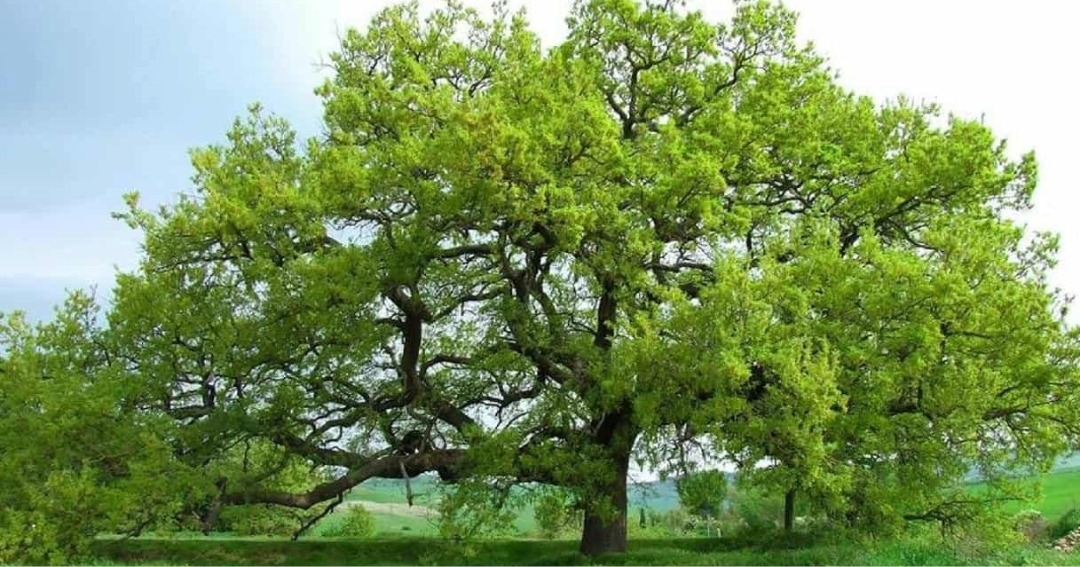
In the heart of the Val d’Orcia, this 300-year-old oak is a true matriarch of the Tuscan countryside. It was the first tree in Italy to be officially declared a “green monument”, a title celebrating its beauty and natural heritage. Its vast crown forms a kind of “green sky”: an elegant web of branches casting wide shade.
Its unique, sculptural structure feels straight out of a fantasy novel. Unsurprisingly, it has long inspired artists, photographers and writers.
The holm oak of Eremo delle Carceri (Umbria)
On the slopes of Mount Subasio, in the silence of the Eremo delle Carceri, grows a legendary holm oak. According to tradition, Saint Francis used to pray beneath this tree. Its thick canopy casts a deep, almost spiritual shade, and its weathered trunk seems to whisper the stories of monks and pilgrims.
Visiting it during your motorhome trip offers a moment of true peace — a perfect stop in the green hills of Umbria.
The yew of Fonte Avellana (Marche)
At the foot of Mount Catria, in the spiritual calm of the Fonte Avellana Hermitage, grows an ancient and imposing yew tree. Its roots wind through the stones of the old monastery, and its dark, knotted trunk carries centuries of prayers, silence and monastic life. Its compact canopy offers cool shade that invites contemplation.
Central Italy is home to trees that seem to be in dialogue with the landscape. Each one invites you to slow down and breathe in the wild, simple beauty of these lands.
3. Southern Italy: where trees smell of sea and ancient civilizations
Southern Italy is intense, sun-drenched and deeply Mediterranean. Here, monumental trees are not just botanical marvels: they are living symbols, shaped by centuries of wind, sun and history. Travelling by motorhome or caravan through these regions, you’ll feel like every ancient tree has a story to tell.
The Vallonea oak of Tricase (Puglia)
A true botanical rarity, the Vallonea is an oak species typically found in Greece and the Balkans. The one in Tricase, also known as the “1000-Year Oak”, is one of the largest in Europe. Its crown stretches impressively wide, and its trunk is so massive it resembles the base of a natural tower.
These trees aren’t just sightseeing spots — they’re living roots of Mediterranean culture.
The Bosnian pine of Mount Pollino (Calabria)
This iconic tree is the symbol of the Pollino National Park, Italy’s largest. Some specimens, like the “Patriarch of Pollino”, are over 1,000 years old.
Their bark resembles medieval armour — hence the name “loricato”. They grow on rocky ridges, exposed to extreme weather that few trees could survive.
Reaching them takes a hike, but the view — with mountains floating between sky and sea — makes the effort unforgettable.
The Chestnut of the Hundred Horses (Sicily)
Perhaps the most famous tree in Italy — and one of the most famous in the world. This ancient chestnut on Mount Etna’s eastern slope is considered Europe’s largest tree by circumference. Legend has it that 100 knights once took shelter under its enormous crown during a storm, hence its evocative name. It is estimated to be over 2,000 years old — maybe even 3,000.
Walking around its multi-trunk base feels almost surreal — more like strolling through a forest than around a single tree. It’s a must-see stop if you love combining nature, volcano views and mythic atmospheres.
The monumental olive tree “Sa Reina” (Sardinia)
In Villamassargia, in southwestern Sardinia, lies one of Italy’s most incredible places: the ancient olive grove of S’Ortu Mannu. Over 700 centuries-old and millennial olive trees create a landscape like no other. Among them, the most famous is “Sa Reina”, the Queen: a monumental olive tree with a majestic presence, considered one of the largest and oldest of the Mediterranean.
Its massive trunk — marked by deep grooves, veins and time-carved cavities — holds more than a thousand years of history. Its wide, luminous canopy casts a perfect cone of shade where the silence seems to have a sound of its own, blending with the rustle of silver leaves in the wind.
Southern Italy and the islands are an invitation to slowness, wonder and discovery — and these monumental trees are the most authentic way to experience it.
Conclusion
Monumental trees are more than just “places to see.” They are silent companions on your motorhome or caravan travels — natural landmarks that speak in their own way, reminding us how precious the landscapes we cross truly are.
Travelling slowly, stopping at a farm or agriturismo, exploring lesser-known places — all of this helps us appreciate the true value of Italy’s natural beauty.
So, the real question is: which tree will you visit first?
Download our app now and try the free demo version to discover the stops closest to the monumental trees you want to visit!
And if you want to truly experience the most authentic side of Italy, get your membership: with Agricamper, you can stay for free for 24 hours at hundreds of carefully selected farms across the country.
Your next motorhome adventure is waiting for you!