When traveling in a motorhome or caravan, water is essential for cooking, washing, cleaning, and living on board in total comfort.
However, it’s easy to forget that water in the tanks doesn’t stay pure for long. Over time, if not properly treated, it can become the perfect environment for limescale, bacteria, and biofilm to form, putting your water system at risk.
A thorough and regular cleaning of the tanks and pipes is not just maintenance, but a real act of safety for the whole family.
This guide will show you how to keep your on-board water clean, safe, and free of bad odors.
Why cleaning your motorhome or caravan water system is essential
As soon as water stops flowing and becomes stagnant, it creates the ideal conditions for the growth of bacteria and algae. During the summer heat, this process accelerates significantly.
One of the main dangers is Legionella, which develops between 25°C and 45°C. This bacterium is not transmitted by drinking the water, but by inhaling droplets during a shower or when using internal taps.
Who is most at risk
Legionella can be particularly dangerous for:
- Elderly people with weakened immune systems.
- Children, whose immune systems are not fully developed yet.
- People with compromised immune systems, such as those undergoing treatments that lower natural defenses.
- People with respiratory issues, which can worsen with bacterial infections.
According to Fabio Viviani, founder of Acquatravel and water treatment expert:
“After just 48 hours in untreated tanks, significant bacterial growth can occur because the systems are not sterile and there are no motorhomes with completely sealed pipes.”
Signs your water system needs cleaning
If your water system isn’t cleaned regularly, the warning signs are clear:
- Unpleasant odor or taste in the water.
- Visible residue in the tank or pipes.
- Small algae appearing in the pipes.
- Taps releasing cloudy water when opened.
In severe cases, contaminated water can cause health problems such as skin irritations or infections.
Risks of not sanitizing motorhome or caravan tanks
Neglecting tank cleaning means exposing yourself and your family to potential health hazards.
The most common issues include:
- Bacterial growth, including Legionella.
- Biofilm formation, a layer that protects bacteria and makes common disinfectants ineffective.
- Limescale buildup, which helps bacteria cling to surfaces and damages pipes.
- Impurities entering during refills, such as sand or leaves.
Proper sanitation eliminates these risks, ensuring safe water not only for drinking but also for washing and cooking.
When to sanitize your tanks
Experts recommend a full sanitation every six months, ideally:
- At the beginning of the season, before your first spring trips.
- At the end of the season, when the vehicle is placed in storage.
If you travel frequently, especially during hot months, it’s best to clean more often as high temperatures speed up bacterial growth.
Cleaning your tanks: the 3 essential steps
Complete sanitation involves three main steps, to be followed in the correct order.
This process ensures a clean and safe water system for both motorhomes and caravans.
Initial preparation
- Completely empty all water: tank, pipes, boiler, and drains.
- Make sure the boiler is empty before starting.
- During each step, open all outlets one at a time, both hot and cold water, until the solution flows evenly without air bubbles.
1) Descaling the system
Why
Limescale builds up on tanks, pipes, and boilers, creating rough surfaces that trap dirt and bacteria. Removing it is essential to protect the system and prepare it for the following stages.
How to do it
- Fill the tank and pipes with a specific descaling solution (e.g., Acquatravel AC26).
- Let it sit to dissolve the deposits.
- Empty and rinse thoroughly with clean water, repeating if necessary.
Estimated time:
24–48 hours, depending on the amount of buildup.
Pro tips
- Grey water tanks can also contain limescale: pour some of the solution into the tank, let it sit for up to 24 hours, then empty and rinse.
Important note: after descaling, you must carry out a full sanitation. When limescale is removed, bacteria trapped inside are released and can circulate freely through the pipes. Eliminating them immediately prevents contamination and bad odors.
2) Removing biofilm
Why
Biofilm is a slimy layer that protects bacteria, making them resistant to regular disinfectants. Removing it is essential to restore a truly clean system.
How to do it
- Use a sanitizing product with oxygen base, safe for drinking water (e.g., Acquatravel Sanigen).
- Fill the system following the initial circulation steps.
- After the contact time, empty while alternating outlets to flush out debris.
- Rinse thoroughly with clean water.
Estimated time:
Minimum 3 hours, up to 24 hours for deep sanitation.
Pro tips
- After treating the fresh water system, run some of the solution into the grey water tank.
- Let it sit for up to 24 hours, then empty and rinse to remove biofilm and bad odors.
3) Shock disinfection against bacteria and Legionella
Why
This step eliminates any remaining bacterial load, including Legionella, which can be inhaled during showers.
How to do it
- Fill the system with a certified disinfectant solution (e.g., Biochlor 300).
- Circulate it through all lines, including the boiler.
- After the contact time, empty and rinse thoroughly.
Estimated time:
About 1 hour of action, followed by neutralization if required by the product.
Pro tips
- Run part of the solution into the grey water tank.
- Let it sit for 1 hour, then add the neutralizing solution (e.g., Declor).
- After another hour, empty and rinse with clean water.
- This step is especially important if elderly people, children, or immunocompromised individuals are traveling with you.
Keeping water clean during refills 💧
Even after full sanitation, water can deteriorate quickly if it remains stagnant. To maintain water quality, follow these two simple yet effective tips:
Use a filter while refilling
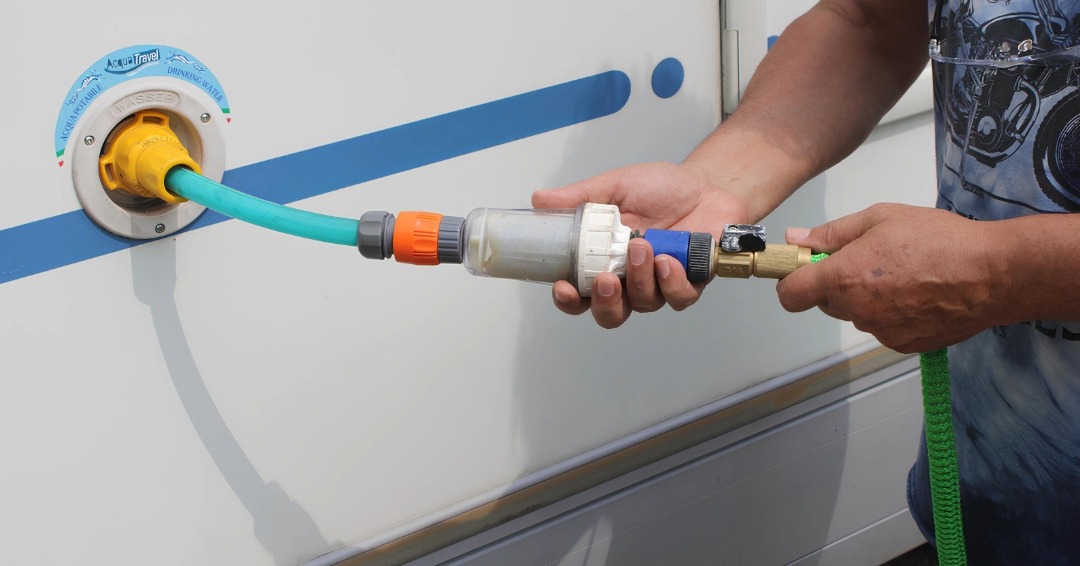
When refilling, impurities like sand, algae, and leaves can enter the system. It’s recommended to use a filter of at least 5 microns on the fill hose.
Examples of Acquatravel filters: Compact Filter, Super Compact Filter
💡 Tip: sanitize the filter regularly by soaking it in a disinfectant solution like Biochlor or AT-Bioclor.
Add a water maintenance product
To keep water clean between sanitations, add a specific product every time you refill.
The treated water will stay safe for 4 days, odor-free, and perfect for showers, cooking, hygiene, and washing vegetables.
Examples of Acquatravel products: AT-Bioclor Single Dose, AT-BICLOR 250 ml, Biochlor 250 1 L.
How to use:
Pour the product directly into the tank and fill as usual: the water will distribute it evenly.
Where to refill and dump water for free in Italy
Keeping your system clean isn’t enough: it’s also important to refill and dump wastewater only in authorized areas. In the Agricamper app, you’ll find all the free dump stations areas in Italy where you can:
- refill clean water,
- dump grey and black water safely,
- respect the environment and local rules.
🔗 Discover free dump stations areas in Italy
Conclusion
By following these three steps — descaling, biofilm removal, and shock disinfection — and keeping water safe between sanitations, your motorhome or caravan will have a clean, protected water system. This means safe water for the whole family!
If you want to travel freely with a motorhome or caravan, Agricamper allows you to stay for free for 24 hours at farms, wineries, and agritourism locations across Italy.
It’s a great way to enjoy authentic experiences, taste local products, and support rural communities while traveling.
🔗 Discover how Agricamper works and the benefits of rural tourism